
Your backlink strategy is only as good as the data (and tools) behind it. The right tools tell you which links are helping, which competitors are outranking you and why, and where your next best opportunity is.
The wrong one leaves you guessing.
But the market is crowded. Some tools are simple browser extensions, while others are enterprise-grade SEO platforms packed with advanced features. The best choice depends on your workflow, goals, and budget.
This guide breaks down the best backlink tools available in 2026, tested and evaluated by real SEOs.
We’ll cover what each tool does well, who it’s best for, how much it costs, and where its limitations begin to show, so you can narrow down the right fit faster.
Whether you’re a solo SEO working with a tight budget or an agency managing multiple client campaigns, you’ll have a much clearer idea of which backlink tools make sense for your situation. 👇
Highlights
- The best backlink tools help you understand which links improve rankings, where competitors are gaining authority, and which opportunities are worth pursuing next.
- Semrush and Ahrefs offer some of the strongest backlink analysis and broader SEO feature sets in this list. At the same time, Moz Pro and SE Ranking focus more on usability, streamlined workflows, and easier day-to-day SEO management.
- Google Search Console remains essential because it gives you free backlink and search performance data directly from Google.
- Hunter.io is an essential outreach support tool (it finds and verifies emails).
- The right backlink tool depends on your goals, budget, and workflow.
How we evaluated these tools
Here’s what we reviewed before selecting the tools for this guide.
(Image by Ioana)
We weighted backlink database quality, freshness, and practical fit more heavily than general SEO features. A tool could score well for keyword research or reporting. Still, it ranked higher only if its backlink data helped SEOs find real link opportunities, audit link quality, or monitor gained and lost links with less manual cleanup.
- Backlink database size and freshness: how many links have been indexed, how quickly new links are discovered, and how often the index is refreshed.
- Data accuracy: does the tool find links that actually exist? Are lost or removed links reflected quickly?
- Feature set beyond backlink checking: rank tracking, keyword research, site audits, outreach. (Tools that do more earn more consideration for teams that want to consolidate.)
- Pricing and value: cost relative to what you get. Free tiers noted. Limits on the free/starter plans are called out.
- User experience: is the interface intuitive? Can a non-specialist pull a backlink report without a tutorial?
- Who it’s actually best for: solo SEO, in-house team, agency, or enterprise — each tool is placed in the context where it performs best.
Quick comparison: best backlink tools at a glance
And here’s a glance at the backlink tools we’re covering. 👇
| Tool | Best for | Free version? | Starting price |
| Semrush | All-in-one SEO + backlink tracking | Limited free account with restricted daily reports and queries | $139.95/mo (save 17% with an annual plan) |
| Ahrefs | Deep backlink analysis + competitor research | Access to limited free tools | $129/mo (save 17% with an annual plan) |
| SE Ranking | All-in-one SEO platform | 14-day trial only | $129.00/mo (save 20% with an annual plan) |
| Moz Pro | Beginner-friendly SEO + authority metrics | 7-day trial only | $99/mo OR$79/mo with an annual plan $49/mo starter plan available for one website |
| Majestic | Link quality analysis | Access to limited free tools | $49.99/mo OR $41.67/mo with an annual plan |
| Google Search Console | Own-site backlink data | Yes | Free |
| Hunter.io | Email discovery for outreach | Limited free searches | $49/mo OR $34/mo with an annual plan |
| Ahrefs Free Backlink Checker (free) | Quick backlink snapshots | Yes | Free |
Now off to the comparison!
The best backlink tools in 2026
According to Conductor’s 2025 State of SEO Survey, 91% of marketers said SEO has positively impacted website performance and marketing goals.
That kind of growth is difficult to sustain without reliable backlink data.
Below are the best backlink tools that consistently stand out in 2026 based on data quality, usability, feature depth, and overall value:
1. Semrush
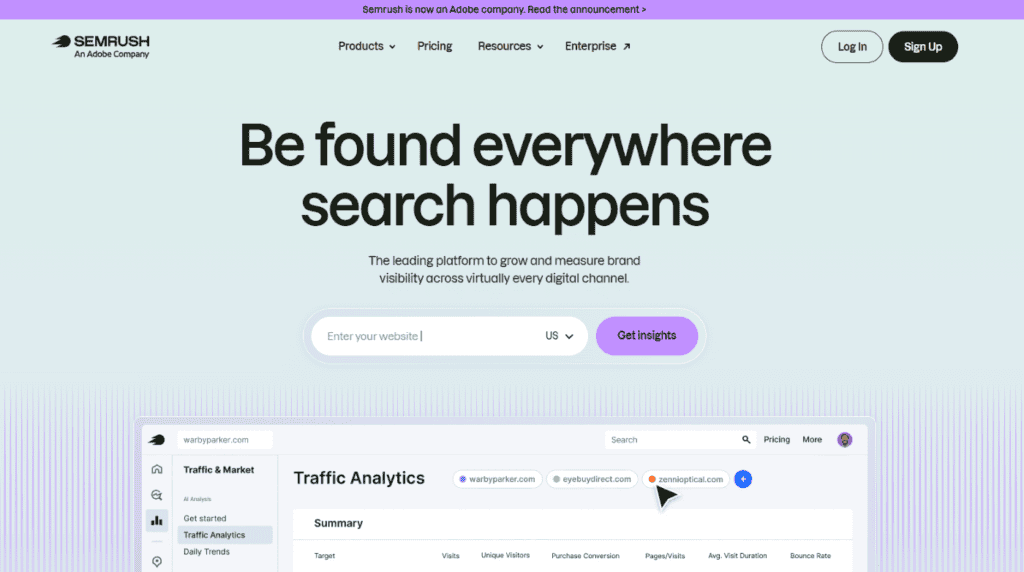
Semrush is one of the biggest names in SEO because it combines backlink analysis with keyword research, rank tracking, competitor analysis, and technical SEO tools on a single platform.
For teams that want everything in one place, it’s one of the strongest options available.
Best for
Teams that want an all-in-one SEO platform with one of the largest backlink databases on the market. Fantastic for SEO content strategy planning.
What it does
Semrush helps you check backlinks, monitor rankings, research keywords, audit websites, and analyze competitors from a single dashboard.
Its backlink tools show which sites link to you, which links were gained or lost, and how strong those referring domains are. The platform updates its database frequently, so backlink data stays relatively fresh.
You can also use Semrush for content planning, technical SEO audits, and tracking search visibility over time.
Standout features
- Keyword research and competitor analysis
- Easy-to-read reports and dashboards
- Fast backlink discovery and updates
- Large backlink database
- Rank tracking tools
- Built-in site audits
Pricing
Semrush starts at around $140 per month, which makes it one of the more expensive SEO tools on the market.
There’s a free version, but it has fairly strict limits on searches and reports. Most teams need a paid plan to use the platform properly.
Limitations
Semrush can feel overwhelming at first because it includes so many tools and reports.
It’s also expensive for freelancers or smaller businesses that only need backlink tracking instead of a full SEO platform.
2. Ahrefs
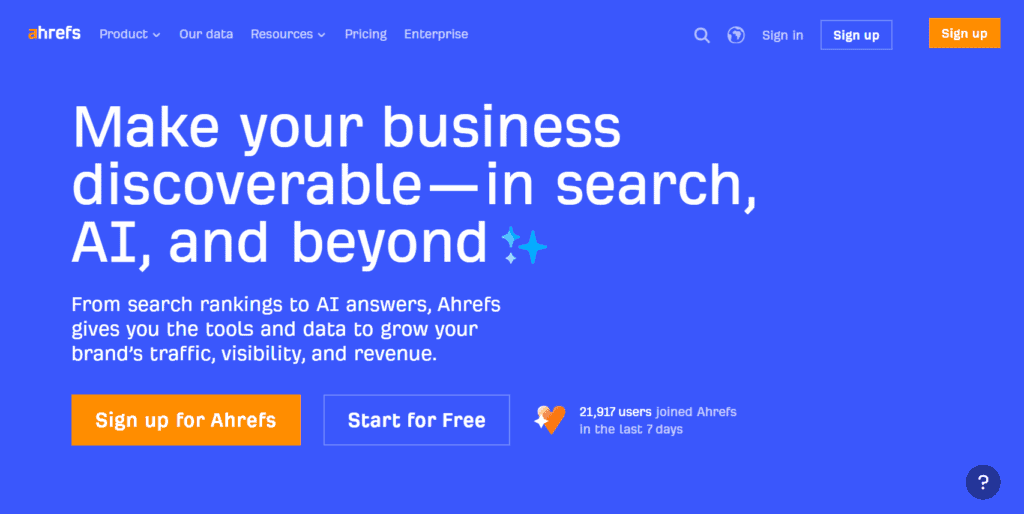
Ahrefs is widely known for its backlink data quality and competitor research capabilities. It’s a favorite among SEO professionals who spend a lot of time studying why certain pages rank and where competitors are earning editorial links.
Best for
SEOs who prioritize link prospecting, competitive backlink analysis, and content research in a single tool.
What it does
Ahrefs helps you break down a website’s organic search performance and backlink profile.
You can analyze which pages drive the most traffic, identify where competitors are earning backlinks, uncover content gaps, and evaluate link quality across referring domains. The platform also helps with keyword research, SERP tracking, and monitoring ranking changes over time.
Standout features
- Clean interface that’s easier to navigate than many enterprise SEO tools
- Content Explorer for finding high-performing topics and pages
- Helpful visualizations for link growth and ranking trends
- Site Explorer for deep organic traffic insights
- Strong filtering options for backlink analysis
- Detailed competitor comparison tools
Pricing
Ahrefs’ full SEO plans start at $129 per month, though a very limited $29 Starter plan is now available.
There’s no full free plan, but verified site owners can access limited tools through Ahrefs Webmaster Tools. Most advanced backlink and research features require a paid subscription.
Limitations
Pricing can be challenging for smaller businesses or freelancers, especially when additional users or projects are added.
Some users also find the platform restrictive in terms of report limits and data exports on lower-tier plans.
While Ahrefs covers several areas of SEO well, it’s less focused on broader marketing workflows such as CRM integration, outreach management, and paid campaign reporting.
3. SE Ranking
SE Ranking has become a popular alternative to larger SEO platforms.
It offers a strong mix of backlink analysis, rank tracking, and website auditing. It also includes relatively high project limits and feature depth compared to similarly priced SEO platforms.
Best for
Agencies and freelancers who want an all-in-one SEO platform.
What it does
SE Ranking helps users monitor backlinks, track keyword rankings, audit websites, and research competitors from one platform.
Its backlink checker lets you review referring domains, anchor text, link quality, and newly gained or lost backlinks. The platform also includes keyword tracking across multiple locations and devices, as well as technical SEO auditing tools to identify site issues.
Standout features
- Higher project limits than competing SEO platforms at similar pricing tiers
- Strong rank tracking with local and mobile data
- White-label reporting options for agencies
- Backlink monitoring with historical data
- Simple interface that’s easy to learn
Pricing
SE Ranking plans currently start at around $129 per month, with lower pricing (20% off) available on annual billing. Add-ons for agency reporting, AI search tracking, and API access increase the overall cost depending on your workflow needs.
SE Ranking is still cheaper than many enterprise SEO platforms when you compare feature depth, especially for agencies needing white-label reporting and rank tracking.
Limitations
Its backlink database is smaller than those of Semrush or Ahrefs, so highly competitive industries may uncover fewer links or make slower discoveries in some cases.
Advanced competitor research and content tools also aren’t as deep as what you’ll find on larger enterprise platforms.
While the interface is user-friendly overall, some reporting and workflow areas may feel less polished than those of premium competitors.
4. Moz Pro
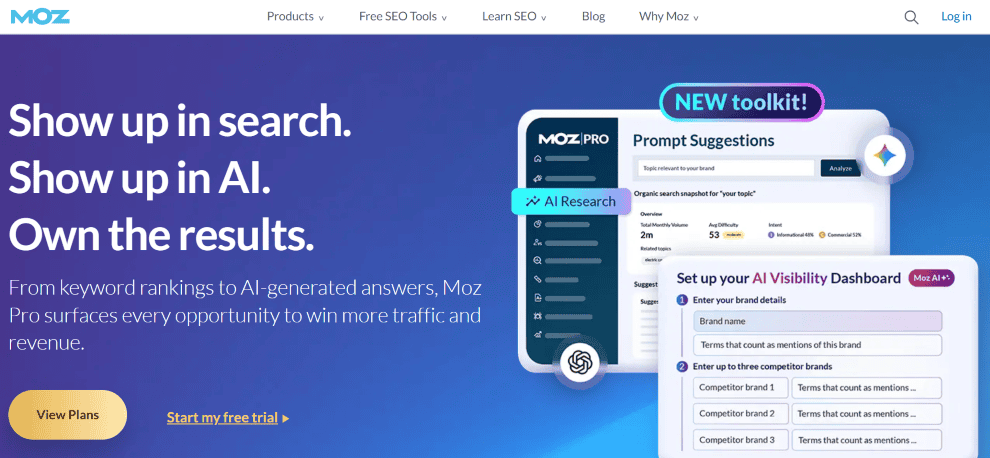
Moz Pro has been part of the SEO industry for years and remains popular with teams that want reliable SEO tools without the complexity of larger enterprise platforms.
Its interface is approachable, and its Domain Authority metric is still widely referenced across the industry.
Best for
Teams that prioritize stability, a trusted authority metric (Domain Authority), and a clean, approachable UI.
What it does
Moz Pro helps users track rankings, analyze backlinks, research keywords, and monitor overall website SEO performance.
Its backlink tools let you review referring domains, anchor text, spam signals, and link authority scores. The platform also supports keyword tracking and site audits, giving teams a central place to manage core SEO tasks without an overwhelming workflow.
Moz Pro is especially useful if you want dependable SEO reporting with a gentler learning curve.
Standout features
- Strong educational resources and community support
- Domain Authority metric widely used across SEO
- Solid keyword tracking and site auditing tools
- Easy-to-understand SEO recommendations
- Useful spam score analysis for backlinks
- Beginner-friendly interface and reporting
Pricing
Moz Pro starts at around $99 per month, placing it below some larger enterprise SEO platforms but still firmly in the professional SEO category.
It also offers a Starter tier at $49 per month — but most businesses outgrow that plan fairly quickly.
A free trial is available, though ongoing access requires a paid subscription.
For smaller businesses or marketing teams that value simplicity, the pricing can feel more manageable than some competitors.
Limitations
Moz’s backlink database is smaller than those of platforms like Ahrefs or Semrush, which can limit the depth of link discovery in competitive industries.
Its backlink index also tends to refresh less aggressively than some larger competitors, so newly gained or lost links may take longer to appear.
Advanced competitor analysis and content research features are also less robust than those in more enterprise-focused SEO suites.
5. Majestic
Majestic is one of the few SEO tools built almost entirely around backlinks. Instead of trying to be an all-in-one marketing platform, it focuses heavily on link intelligence and historical backlink analysis.
Best for
SEOs who want a dedicated backlink intelligence tool with proprietary metrics and two distinct link indexes.
What it does
Majestic helps users analyze backlink profiles, evaluate link quality, and study link relationships between websites.
The platform is known for its Trust Flow and Citation Flow metrics, which measure link quality and influence. Users can explore referring domains, anchor text patterns, topical relevance, and historical backlink growth across websites.
Majestic also offers a large historical link index, making it useful for long-term backlink analysis and competitor research.
Standout features
- Good for link auditing and prospecting workflows
- Trust Flow and Citation Flow authority metrics
- Strong focus on backlink intelligence
- Large historical backlink database
- Detailed backlink filtering options
- Useful topical link analysis
Pricing
Majestic is generally more affordable than full enterprise SEO software suites, with plans starting at around $50 per month.
Pricing scales based on data access and reporting limits, making it accessible for freelancers and smaller SEO teams focused mainly on backlink analysis.
Limitations
Majestic is much more specialized than tools like Semrush or Ahrefs, so it lacks strong keyword research, content optimization, and technical SEO features.
The interface can also feel dated compared to newer SEO platforms, especially for beginners.
Teams looking for an all-in-one SEO workflow usually need additional tools alongside Majestic.
6. Google Search Console
Google Search Console is one of the most valuable free SEO tools available because the data comes directly from Google itself. While it isn’t a dedicated backlink platform, it gives website owners direct visibility into how Google views their site.
Best for
Every website owner. It’s free, it’s from Google, and it shows you exactly which links Google has indexed for your site.
What it does
Google Search Console helps users monitor website performance in Google Search.
You can track keyword impressions, clicks, indexing issues, page performance, and technical SEO problems. The platform also includes backlink reporting. It shows which websites link to your domain most often and which pages attract the most external links.
For SEO teams, it is a foundational tool for monitoring visibility, indexing health, and organic traffic trends.
Standout features
- Easy integration with Google Analytics and other Google tools
- Free access to Google search performance data
- Backlink reporting directly from Google
- Keyword impression and click tracking
- Indexing and crawl issue monitoring
- Core Web Vitals reporting
Pricing
Google Search Console is completely free to use.
There are no paid tiers, which makes it one of the highest-value SEO tools available to businesses of any size.
Limitations
Its backlink reporting is fairly limited compared to dedicated backlink tools like Ahrefs or Majestic.
You won’t get advanced link metrics, competitor backlink analysis, outreach features, or detailed historical backlink tracking.
The interface can also feel basic for agencies or enterprise SEO teams managing large-scale reporting workflows.
7. Hunter.io
Hunter.io is less focused on backlink analysis itself and more focused on helping teams turn link opportunities into real outreach campaigns.
SEOs and digital PR teams use it as a simple way to find contact information.
Treat Hunter.io as an outreach add-on, not a backlink database. It belongs in the stack after a backlink tool has already identified the target sites worth contacting.
Best for
SEOs running link building outreach campaigns who need to find and verify email addresses at scale.
What it does
Hunter.io helps users find professional email addresses connected to websites and verify their validity.
For link building, this makes it easier to contact editors, journalists, bloggers, and website owners without having to manually search for contact details. The platform also supports basic outreach campaign management. Teams can organize follow-ups and track replies.
It works best as a supporting tool alongside backlink research platforms.
Standout features
- Helpful for digital PR and link outreach workflows
- Email verification tools to reduce bounce rates
- Simple outreach campaign management
- Chrome extension for quick prospecting
- Clean and beginner-friendly interface
- Fast domain-based email discovery
Pricing
Hunter.io offers a limited free plan with monthly search and verification credits.
Paid plans start at around $49 per month, with pricing increasing based on the number of searches, verifications, and outreach campaigns you need.
For smaller agencies and freelancers, it’s usually more affordable than enterprise outreach platforms.
Limitations
Hunter.io is not a backlink analysis platform, so it doesn’t provide backlink indexes, authority metrics, or SEO auditing features.
Its outreach tools are also fairly lightweight compared to dedicated sales engagement or PR platforms.
Data accuracy can vary across companies or websites, so some manual verification is still necessary.
8. Ahrefs Free Backlink Checker
Ahrefs Free Backlink Checker is a simplified version of Ahrefs designed for quick backlink research.
Best for
Anyone who wants a quick backlink snapshot of any domain without a paid subscription.
What it does
The tool lets users check the top backlinks pointing to a website or webpage.
You can view referring domains, anchor text, link strength indicators, and a small sample of backlinks connected to a domain. It’s useful for basic competitor research, quick audits, or validating whether a page is attracting links.
Because the data comes from Ahrefs, the backlink quality is generally strong even in the free version.
Standout features
- Shows top referring domains and backlinks
- Simple and beginner-friendly interface
- Pulls data from Ahrefs’ backlink index
- Useful for quick competitor checks
- No complicated setup required
- Completely free to use
Pricing
The backlink checker itself is free.
But the data is more limited than on the full Ahrefs platform. Users who need deeper backlink analysis or larger exports eventually need a paid Ahrefs subscription.
Limitations
The free version only shows a small portion of backlinks and referring domains.
It also lacks advanced filtering, historical backlink tracking, keyword research, and technical SEO features available in the full Ahrefs platform.
For ongoing SEO campaigns or agency reporting, the tool is usually too limited to function as a primary solution.
How to choose the right backlink tool for your situation
No matter where you are in SEO, there’s a backlink tool setup that fits your needs.
For example …
(Image by Ioana)
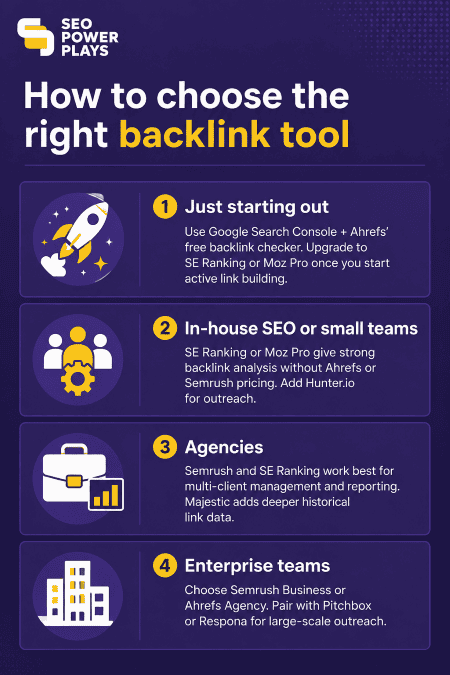
If you’re just starting out
Start with Google Search Console (free) to understand what links you already have. Pair it with Ahrefs’ free backlink checker for quick competitor snapshots.
Once you’re running active link building campaigns, most paid tools’ free tiers won’t be enough. Budget for at least a starter plan on SE Ranking or Moz Pro.
If you’re an in-house SEO or small team
SE Ranking or Moz Pro offer the best value for teams that need full backlink analysis without the Semrush/Ahrefs price tag. Add Hunter.io for outreach, and you have a complete link-building stack for under $150/month.
If you’re an agency
Semrush or SE Ranking is the strongest agency choice. Both offer multi-client management, white-label reporting, and the depth of data to support client deliverables.
Majestic is worth adding for its Historic Index and Topical Trust Flow data. (Especially helpful for auditing sites with complex link histories.)
If you need enterprise-grade coverage
Semrush at the Business tier or Ahrefs’ Agency plan is best. For outreach at scale, pair with Pitchbox or Respona instead of Hunter.io.
Pick the tool that fits your current stage
The best backlink tools are those that align with your current goals, budget, and workflow. They are not necessarily the tools with the biggest databases or the most features.
If you’re new to backlink analysis, start with Google Search Console and a few free tools. That’s usually enough to monitor backlinks, understand search visibility, and learn what matters … before spending hundreds per month on software you may barely use.
Once you’re actively running SEO campaigns, publishing consistently, or building links at scale, consider upgrading. Ahrefs, Semrush, or SE Ranking start making more sense.
Then, when your outreach process becomes consistent, add tools like Hunter.io to speed up prospecting and relationship-building.
One well-chosen tool used consistently will almost always outperform three platforms you barely touch.
For more in-depth guides on link building, outreach, and SEO tools, subscribe to SEO Power Plays for practical SEO breakdowns, tool comparisons, and strategy updates.
FAQs
What is a backlink tool?
A backlink tool is software that crawls the web to identify which external websites link to a given domain or URL. Better tools also show metrics such as domain authority, anchor text, and link type (dofollow/nofollow), as well as historical data so that you can assess link quality and track changes over time.
Are free backlink tools worth using?
Yes, for specific use cases, free backlink tools are worth using.
Google Search Console is essential and free. Ahrefs’ free checker is useful for quick snapshots. For ongoing campaigns with competitor analysis, filtering, and outreach integration, a paid plan is worth the investment.
How many backlink tools do I actually need?
Most teams do well with:
- One outreach tool (Hunter.io for most, Pitchbox for high-volume campaigns)
- One core backlink analysis tool (e.g., Semrush, Ahrefs, or SE Ranking)
- Google Search Console (always)
What’s the difference between a backlink tool and a link building tool?
Backlink tools analyze existing link profiles — yours and your competitors’.
Link building tools help you find new link opportunities and manage outreach. Many platforms (e.g., Semrush, Ahrefs) do both. Some tools specialize in one. (For instance, Majestic is backlink analysis only; Hunter.io is outreach only.)