
If the saying “The best things in life are free” applies to anything, it`s high-authority editorial links.
They’re organic and provide real user value, so search engines trust and reward them.
When a website links to an external piece of content without a request, that’s an editorial link. You earn them by creating high-quality content and by developing an outreach strategy that positions you as a trusted resource.
For SEO, editorial links act like five-star reviews. Signaling to search engines that your content is the best answer.
Signals that can increase your site’s credibility, visibility, organic traffic, and ranking.
In this post, you’ll learn why editorial links are the gold standard in link building, how they drive organic traffic and boost SEO, strategies for getting them, and mistakes to avoid.
Highlights
- Editorial links are earned, not built—and they’re the most trusted SEO signal in 2026. These organic, unsolicited links act like citations or five-star reviews, signaling relevance, authority, and trust to both search engines and AI-powered results.
- High-authority editorial links drive rankings, organic traffic, and long-term SEO value. Because they’re contextual, relevant, and user-focused, they survive algorithm updates and outperform paid, reciprocal, or engineered links.
- The fastest way to earn editorial links is by creating link-worthy assets. Original research, data studies, comprehensive guides, evergreen resources, and visual content give writers a clear reason to cite your site.
- Digital PR, thought leadership, and targeted outreach turn great content into links. Building journalist relationships, using HARO, newsjacking, expert commentary, podcasts, and strategic pitching make it easy and natural to cite your content.
- Quality matters more than quantity—always audit for relevance and context. The best editorial links come from authoritative, topically aligned sites, appear naturally in the body of the content, and avoid red flags such as sponsorship labels, overly optimized anchors, or irrelevant placements.
What are editorial links?
Editorial links are when a writer or editor links to your content because they consider it a valuable resource for their readers.
They function like citations (those 5-star reviews). A content creator makes a claim, supports it with a credible source, and links to the best reference.
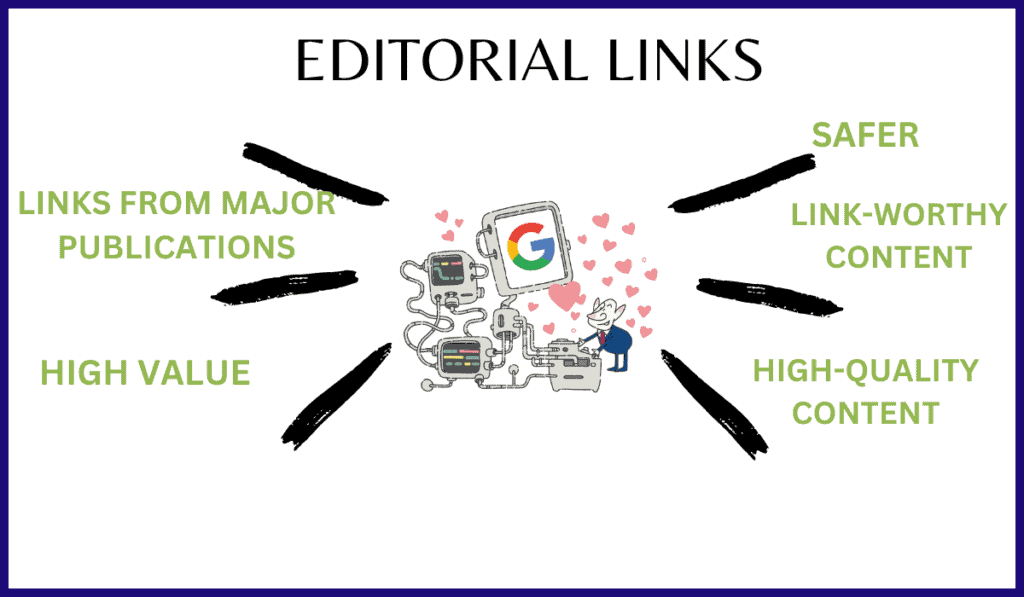
You earn them by creating a valuable linkable asset (i.e., research, guides, data) that a writer or editor can use. And implementing an outsource strategy that puts your content in front of high-authority websites that will link to it.
See how it works?
My link to Search Engine Journal is natural; the site has a high DR/DA score, and I trust SEJ’s content to tell you what you need to know.
Here`s how you identify editorial links:
1. Characteristics that make an editorial link
In SEO, editorial links are the most powerful links to add to your link building strategy. Publishers organically choose to link to content they find relevant, valuable, and worthy of citing as a reliable resource.
Control is the key difference between editorial backlinks and paid links, as publishers decide whom to link to.
How to spot an editorial link:`
- Earned, not paid for: A writer/editor selects a link they find valuable to strengthen their article.
- High authority: You’ll find them in respected industry publications, blogs, and reputable news sites.
- Purposeful context: Organically integrated to support a point, definition, statistic, process, or quote.
- Value: Editorial inbound links provide content that is helpful to the reader.
- Natural anchor text: Naturally placed within the content using a descriptive and relevant anchor text.
2. Examples of editorial links
Editorial links often appear in the following places:
- News articles: A high-authority news site links to a study on a specific impact on a particular industry.
- Study/research citation: A publication references research data to support a claim.
- Policy or documentation citation: A publisher links to an authoritative source (e.g., a gov website) to clarify a rule or standard.
- How-to guides: A pet site links to a detailed guide on raising puppies.
- Expert quote attribution: A writer includes your quote to emphasize a point and links to your profile.
- Resource citation: A how-to guide links to your tool, template, or checklist because it adds real value.
- Blog Post: A tea blog reviews new tea subscriptions and links to your tea subscription service.
3. How editorial links differ in context and placement
Website owners choose where to place editorial links to maximize the value of their content and meet readers’ needs.
Editorial links appear organically within the main body of content. Embedded next to the claim they support or to an explanation from another source.
That placement matters.
The link isn’t floating in a generic section. It ties to the meaning, and the surrounding content provides context by explaining why your resource is helpful for the reader.
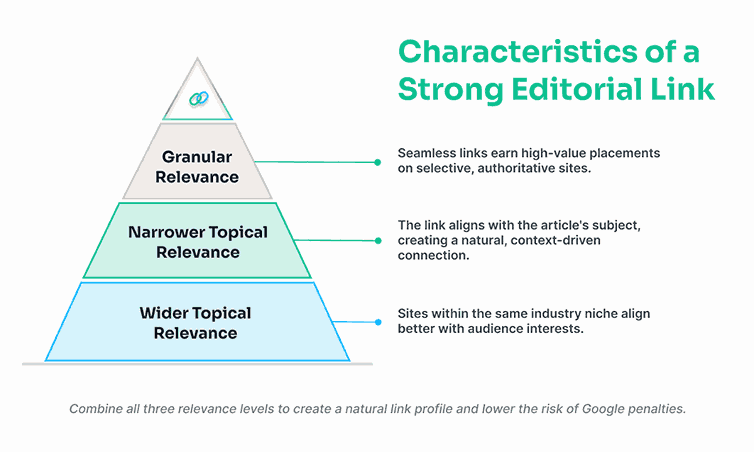
Why editorial links matter for SEO
Editorial links matter in 2026 for SEO because they signal relevance, trust, and authority to search engines.
And if 2025 taught us anything, it’s that Google’s cutting the chaff, and the sites that’ll rank are those its algorithm trusts.
If you earn that trust, it could increase your site`s search rankings and organic traffic.
But Link building is not about link quantity; it’s about quality.
Editorial links combine two qualities that matter most in modern SEO.
- They provide genuine usefulness to users.
- They help search engines find relevant information.
This combination keeps editorial links evergreen. Surviving algorithm updates, while other link types are often discounted.
Five reasons editorial links matter for SEO:
- Authority and trust: When a high-authority domain links to your content, it tells search engines your content answers the question.
- AI search: AI uses online mentions to find and display relevant information, and links from authoritative sources validate your domain’s relevance.
- Organic traffic: Editorial backlinks drive organic referral traffic from authority domains. Sending highly convertible users to your site.
- Search rankings: Editorial links are primary ranking signals in both traditional and AI search results.
- Evergreen value: Links earned through relevance and value provide consistent visibility and growth.
Google’s perspective on earned vs. built links
Google says that paid links “distort the integrity and fairness of search results.”
And it’s a fair assessment because paid links allow websites to buy ranking positions rather than earn them.
Google’s official stance:
- “Paid links that pass PageRank are a violation of its spam policies and can result in penalties, while earned links are the organic, high-quality endorsements that help a site build authority and credibility.”
In contrast, editorial/earned links are the “holy grail” of links. Unlike black-hat link building, they are organic, unsolicited endorsements from other websites.
Benefits for domain authority and rankings:
Editorial links from relevant, trusted sites help increase domain authority and rankings by:
- Improving trust signals through contextual references
- Increasing discovery and crawl frequency
- Driving qualified referral traffic
- Reinforcing topical authority
Trust signals and credibility factors:
Editorial links reinforce credibility because search engines see them as citations that are:
- Independent: Natural with no obligation, payment, or exchange
- Source-driven: Use real and valuable reference content
- Contextual: Embedded where they make sense
Long-term SEO value compared to other link types:
The compound effect of editorial links is invaluable for SEO and a proven way to naturally outrank big brands.
SEO value compared to other link types:
- Engineered links are unnatural and can become liabilities during spam updates, destroying a site’s rankings overnight.
- Editorial links from high-ranking, trusted articles drive referral traffic to the cited website.
- Editorial links comply with Google’s EEAT standards and link spam policies.
Editorial links vs. other link types
Editorial links are the “gold standard” of white-hat link building strategies. Whilst some other link types offer SEO benefits and are worth pursuing, others provide no real value and are not worth the risk.
Editorial links vs. paid links
Unlike editorial links, which search engines trust, paid links are manipulative because they come from paid placements, link schemes, or spammy networks.
Paid links can boost traffic/rankings in Google SERPs, but carry a high risk of penalties and devaluation by search engines.
Editorial links vs. guest post links
You earn guest post links by providing high-quality content to relevant websites through paid or solicited placements.
Guest posting links build authority, but they’re less valuable than editorial links, which act as genuine endorsements.
Editorial links vs. directory links
Directory links are niche resource pages on authoritative websites that link to relevant businesses and content that provide value to their users.
Search engines use directory links to verify a company’s relevance and legitimacy. Whilst directory links offer less authority than editorial links, they`re essential for local SEO and visibility.
Editorial links vs. reciprocal links
Reciprocal links are a give-and-take link building strategy.
Unlike editorial links, which are organic, reciprocal links are an agreement between two websites to link to one another.
Search engines accept relevant reciprocal links, but view excessive use as rank manipulation.
How to earn editorial links
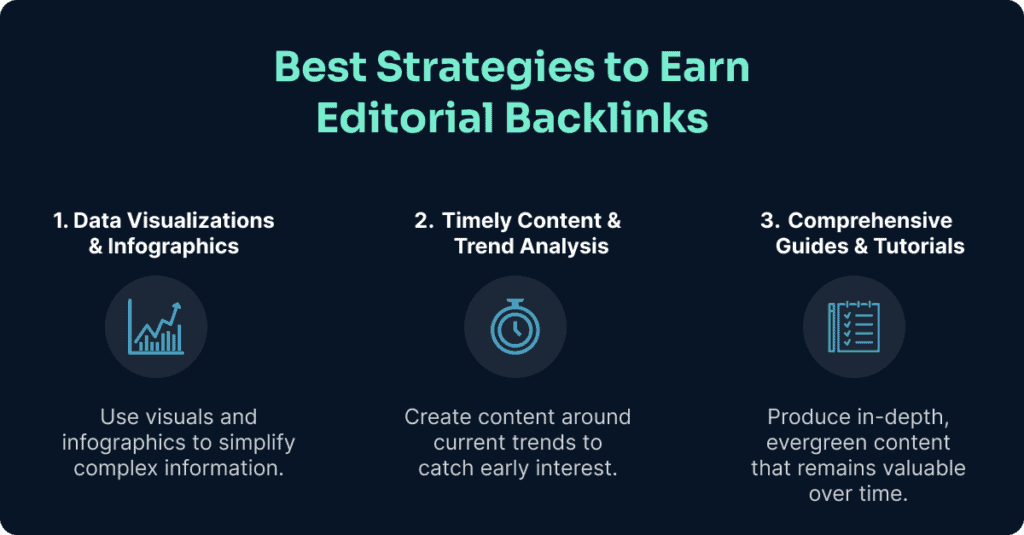
To earn high-authority editorial links in 2026, you must create a link building strategy with high-value, link-worthy assets and a targeted promotion campaign.
And that begins with your content.
Create link-worthy content
Editorial links connect to content that helps writers explain, prove, or clarify something. You attract them by creating linkable assets such as:
- Comprehensive guides: Create in-depth tutorials, how-to-guides, and ultimate resources with examples and explanations
- Original research: Produce original surveys or statistics that publishers can use to support their claims
- Data studies: Analyze existing datasets to reveal trends and shifts in specific markets and industries
- Evergreen content: Produce timeless content that remains relevant and useful to readers
- Visual content: Provide high-value infographics, interactive tools, or videos
Grow your digital PR and outreach strategy
Now is when you use your content and relationship-building skills to earn editorial links.
It involves creating campaigns, expert commentary, or newsworthy content for journalists that builds credibility and influence, secures editorial links, and places it where publishers will see it.
- Use HARO (Help a Reporter Out) to provide publishers with publication-ready content, such as quotes or statistics they can use.
- Create press releases that include tangible assets and real news, such as events or announcements, that editors can link to.
- Build journalist relationships by offering relevant insights and evidence that support their claims.
Your digital PR and outreach strategy’s goal is simple: make your writing the story—and make citing you easy.
Become a thought leader
Thought leadership earns editorial links by making you a highly reliable, quotable source that Google rewards and people trust:
- Newsjacking to gain links: Insert your expertise into trending news stories to attract high-quality editorial links using the what-why-when-and how journalistic technique.
- Provide expert commentary: Publish concise, evidence-based information with examples that describe the impact of an update or event within your niche.
- Build topical authority: Become a trusted resource by developing expertise in a specific niche and ensuring your content is the go-to source for citations.
- Speaking engagements: Increase your visibility using speaker pages or recap posts by providing a concise round-up of an event or presentation.
- Podcast appearances: Earn editorial links by appearing on podcasts and inserting your backlink in the episode’s show notes.
Content promotion
Even the strongest resources need visibility to get editorial links.
Effective promotion includes:
- Share visual data snippets on social platforms.
- Email writers who’ve covered similar stories.
- Pitch publishers already covering the topic.
How to identify quality editorial links
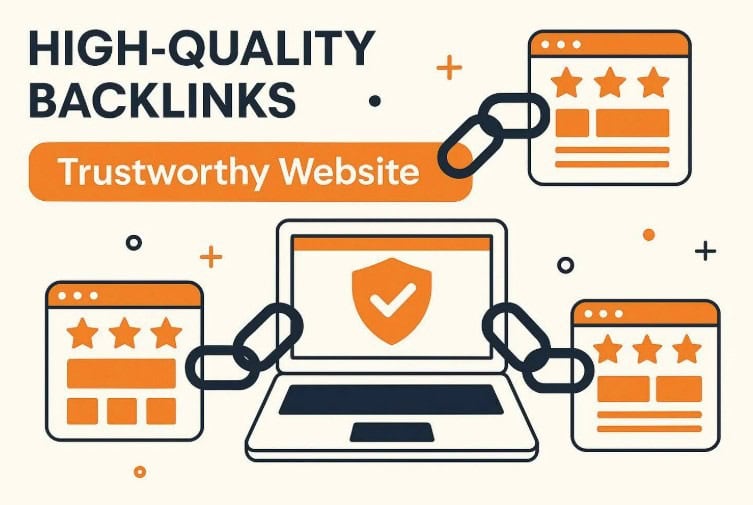
Not all editorial links are equal, but a simple audit can help identify those that offer real value.
Evaluating link quality:
- Domain authority: Ensure the link comes from a site with high Domain Authority (DA), real user engagement, and organic traffic.
- Relevance: Ensure the editorial linking page’s content is relevant to the link and serves a similar audience.
- Context: The link should appear naturally within the body of the content, with a supporting narrative.
Red flags that suggest a link isn’t truly editorial:
Non-editorial links (such as paid, spammy, or artificial links) fly several red flags.
- Anchor text over-optimization: Links packed with exact match keywords that only exist for SEO (e.g., “cheap business loans”).
- Irrelevance: Links coming from unrelated websites or content (e.g., a link to a business insurance site from an SEO blog)
- External link overload: Articles with a high number of external links directing to unrelated content
- Unnatural phrasing: Poorly written or unnaturally sounding text surrounding a link
- Sponsored content: Clear labeling of sponsored content shows paid placement
Tools for analyzing your backlink profile:
Your backlink analysis confirms your Domain Authority (DA) and link Spam Score (SS).
It also identifies link building opportunities, competitors’ links, and measures your link building effectiveness.
Use SEO online tools like:
- Moz Link Explorer: Data on link Spam Score, Page Authority (PA), and Domain Authority (DA) to assess site strength and link quality.
- Google Search Console: Provides a free, reliable Google perspective/report on your website’s link quality.
- Ahrefs: Provides link quality insights, identifies link opportunities, and facilitates competitor analysis.
- Semrush: Offers backlink analytics, link building tools, and link-toxicity scores.
Common mistakes to avoid
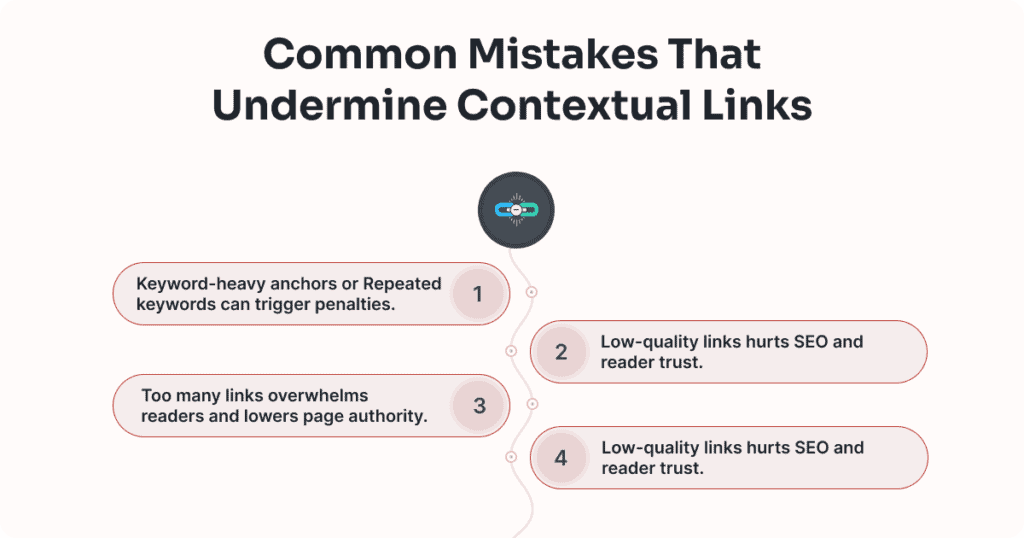
Let’s wrap up with the mistakes to avoid in your backlink building strategy.
Content and strategy mistakes:
- Quantity over quality: Creating multiple low-value links with no user value instead of a few high-quality ones
- Ignoring genuine relationships: Not building media partnerships with writers, bloggers, journalists, or editors
- Not following up: Failing to send follow-up emails to prospects highlighting your content’s value to their users
- Low-value linkable assets: Creating low-quality content that offers no real user value
- No diversification: Using a single tactic instead of a diverse link building strategy
- No relevance: Prospecting for links from unrelated niches with no topic relevance
- Generic outreach: Using a one-size-fits-all email with little value for the prospect
- Manufacturing links: Gaining editorial links through manipulation
Conclusion
Editorial links are the “gold standard” of link building.
Like gold, they`re rare, but when you earn them, the SEO rewards are priceless.
These unsolicited endorsements signal to search engines that your content provides the best available answer, reinforcing your site’s authority, trust, credibility, visibility, organic traffic, and rankings.
Editorial link building is a long-term SEO strategy that takes time and perseverance, but the sooner you start, the quicker you`ll reap the rewards.
Begin by auditing your current backlink profile or creating your first link-worthy asset. And subscribe to SEO Power Plays to stay up to date on the latest link building strategies, SEO news, and trends.