
Enterprise SEO fails when it’s run like startup SEO.
Most of our clients at uSERP today are enterprise. But I’ve spent the last decade doing both, and this in-house uSERP framework has been core since day one.
I’ve taken startups from zero, as in literally creating their first blog parent page, to outranking NerdWallet in consumer finance in under 12 months with 70,000 visits/month and 20,000+ new SaaS users acquired. And I’ve driven $1,680,000 in (directly attributed) added ARR from ONE SINGLE PAGE for enterprise brands.
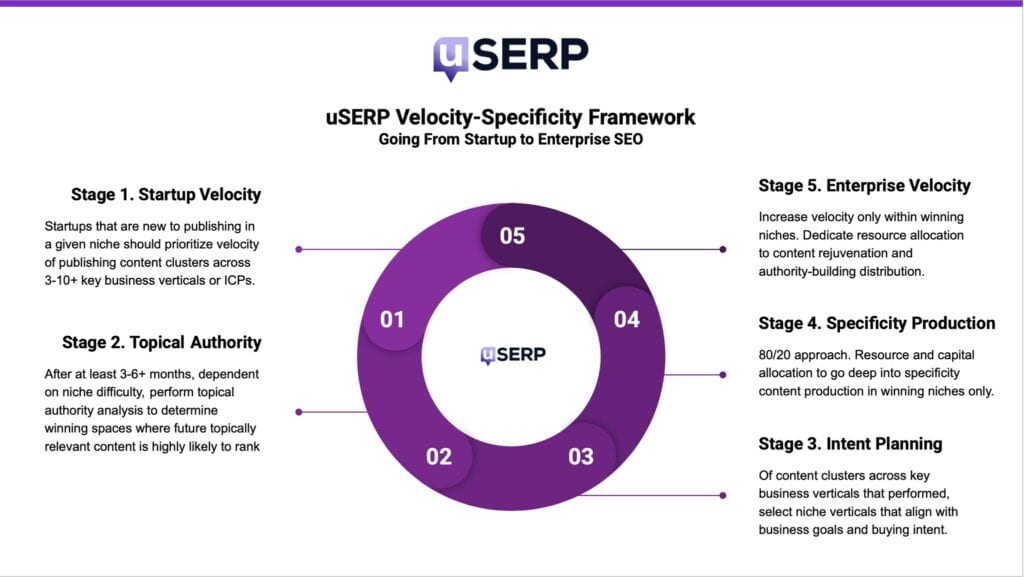
Same channel, but a completely different game. This is where frameworks come in. To help you understand where you are now, and what you need to do to reach your desired destination all while preventing excess waste in the form of time and money.
🚀 Stage 1–2: Startup Velocity → Topical Authority
Startups entering SEO have nothing to go on. No data. No authority. No predictive signal. You can’t “optimize” your way to growth when there’s nothing to optimize. So startups must do one thing well: move fast and break things.
The best place to start is to publish broadly across multiple ICPs. For example, if you are entering consumer finance, you could target content clusters related to credit scores, budgeting, banking, and taxes. All distinct, individual segments with their own topics and thus topical authority.
The point here is to test aggressively across multiple spaces within your business functions. Velocity matters more than precision because learning is the only goal.
Publish like crazy in multiple verticals, wait 3-6 months, then anaylze and move to the next stage.
🏦 Stage 3–4: Intent Planning → Specificity Production (Enterprise Territory)
Enterprise brands are not startups. You already have years of data, clear winning ICPs and clusters, proven intent, and brand authority….so start acting like it. SEO is no longer a growth experiment for you. It’s no longer about paying to learn and seeing what works. It’s a capital and resource allocation game.
There is no publishing 1,000 pages “to see what works” or producing even efforts applied to distribution and optimization. You already know what has traction. Which means as an enterprise, your SEO decisions carry massive opportunity cost:
• Which URLs get 80% of link equity this quarter
• Which BOFU pages are benched while authority builds elsewhere
• Which legacy content is left to decay (and thus left for startup SEOs to fill the gaps)
• What technical issues actually unblock revenue vs tick off boxes
🤖 Stage 5: Enterprise Velocity (Within Constraints)
At scale, velocity only returns value inside winning lanes. High-performing enterprise SEO starts to look an awful lot like portfolio management in this case:
- Capital flows to highest-return assets
- Underperformers get consolidated or cut
- Neutral assets get parked until the data says otherwise or more budget is unlocked to push new lanes
That’s how the best enterprise brands “do less” on the surface, yet grow faster.
And that’s exactly how you build from a startup doing SEO to enterprise mentalities that turn organic into a meaningful % of revenue.
Using the Velocity-Specificity Framework helps you identify where you are in your stage of SEO growth, and subsequently which levers to pull in that stage for maximum return on capital.
If you’re a scrappy new startup, your goal isn’t to create one precious ultimate guide on X topic and pray it ranks. Your goal is to create dozens of content clusters in nearly every niche that your product or service ties into, see what sticks early, and then hammer it with more content.
If you’re an enterprise, your game is capital and resource allocation. And you have traction and years of data to analyze and determine where that capital will produce the highest return.
To win in SEO, startups need to stop trying to do enterprise SEO. And enterprises need to act like enterprises.