
Brands that (A) use SME writers who add personality, real customer language, stories, and conversations that don’t exist online and (B) build AI systems pulling from internal libraries of documented customer conversations, data, and more will dominate content this year.
Brands that use AI not as a fake expert to churn out mass content but as a system trained on their own internal reality from inputs never existing in public domain are going to take off.
They are going to capitalize on massive AI fatigue and become true, trusted brand leaders. People are sick of AI slop and blogs that are clearly the result of shallow prompts like “you’re a marketing expert, write me XYZ article.” Subject matter expertise literally cannot be automated without…actual inputs that don’t exist in the public domain.
Trade secrets and high-leverage information ain’t online for AI to scrape. Offline conversations, private customer conversations, conferences, meeting people in person, customer tickets and chats. If you are relying on AI to “be an SME and write me XYZ article, make it detailed” … people can sniff that out in two seconds. It’s already prevalent with the amount of rage posts on LinkedIn about simple em dashes.
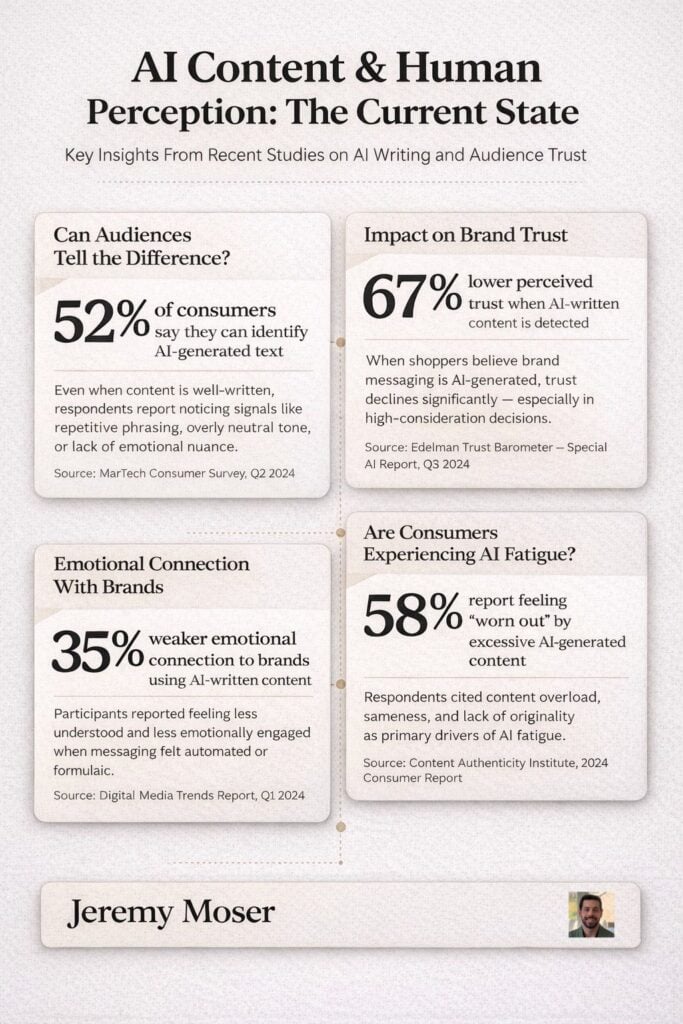
Just because you can ask LLMs to “sounds like a lawyer” doesn’t mean that actual lawyers can’t immediately tell your statements was written by an LLM. There are such subtle nuances that AI has yet to pick up that really can only be gleaned from years of being in the trenches in your space.
AI slop is inundating every platform and fatigue is rising at rapid rates.
But AI is also advancing at such a rate that with proper guidance, prompts, internal content databases, and training, will be able to dramatically increase efficiency and ability to scale higher quality content than we’ve ever seen.
Meaning brands that do this will be able to tap into the ever elusive “quality AND quantity” 1-2 punch.
Currently, there is real brand risk with over reliance on AI. Whether that is publishing mass AI articles and seeing huge crashes in rankings after initial surges, or simply how people view your brand after engaging with the content.
Humans are fantastic at pattern recognition. And when everyone is using the same models to generate content, the same patterns get blasted to your feed at incomprehensible scale, leading to fatigue.
-Jeremy