
Managing a website with millions of pages is like steering a massive ship through a storm.
Minor errors that don’t hurt a small blog can sink an enterprise website in days. When you track thousands of keywords across complex digital ecosystems, basic or manual tools aren’t enough. You need a system that handles huge data loads without crashing.
This is where specialized enterprise SEO software comes in. These SEO platforms help search engine optimization (SEO) teams work together across large departments. They combine massive data sets and team workflows that standard, single-site tools simply cannot handle.
This unbiased, feature-focused guide covers the best enterprise SEO tools available today and how they drive organic growth. Whether you are a CEO, founder, or marketer, these systems help you scale search efforts.
We’ll compare rank tracking, technical audits, and content optimization features to help you find the right SEO strategy. By the end, you’ll know which SEO vendors can actually boost your website traffic.
Highlights
- Picking the right enterprise SEO software means finding a tool that handles large volumes of data and helps big teams work together without the usual headaches.
- Most top SEO platforms now focus on answer engine optimization (AEO) so your brand actually shows up in AI Overviews and Perplexity.
- You need deep technical SEO features like log file analysis to spot where you’re wasting your crawl budget on millions of pages.
- Good enterprise SEO tools use automation to handle boring SEO tasks, giving your marketing and dev teams more time for big wins.
- Finding the perfect fit isn’t just about features. It is about how easily your team uses the tool and the cost of keeping it running over time.
What is enterprise SEO software, and why is it necessary?
Enterprise SEO software is a high-powered suite of tools for sites with thousands or millions of pages. The difference from standard SEO software is that it goes beyond finding keywords or checking backlinks. These tools focus on scale and security.
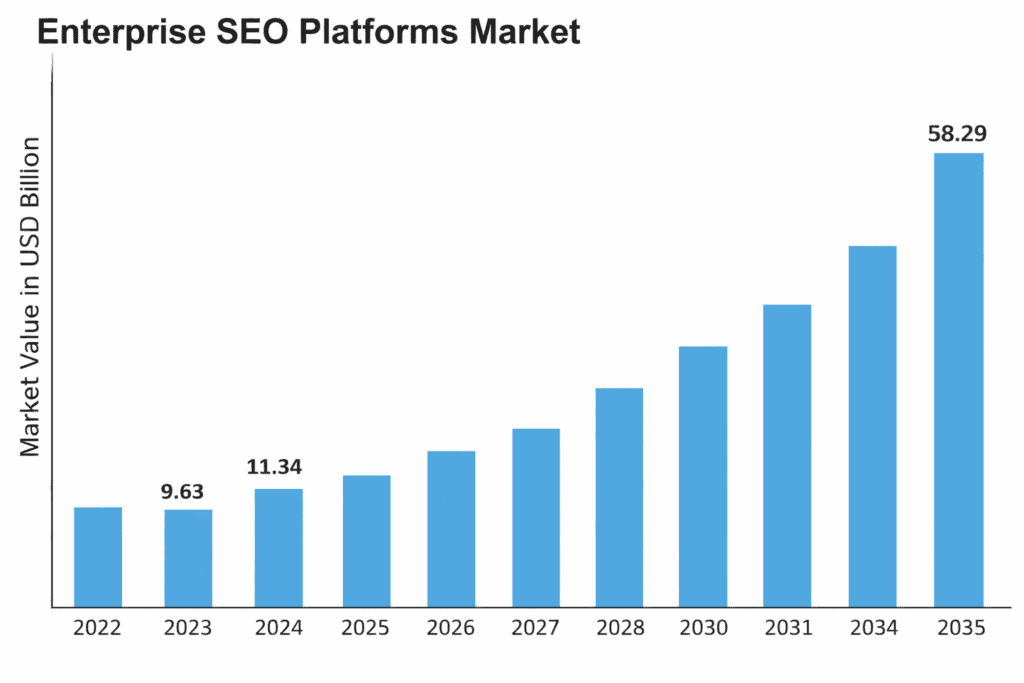
According to the Enterprise SEO Platforms Market report, this market was valued at $11.35 billion in 2025. It’s expected to reach $58.29 billion by 2035. Companies now realize they can’t manage global visibility with just spreadsheets.
What sets these tools apart is their focus on custom workflows. Large companies have many people involved, from content creators to developers. Conductor’s 2025 State of SEO Report notes that better collaboration is a top goal for dev teams.
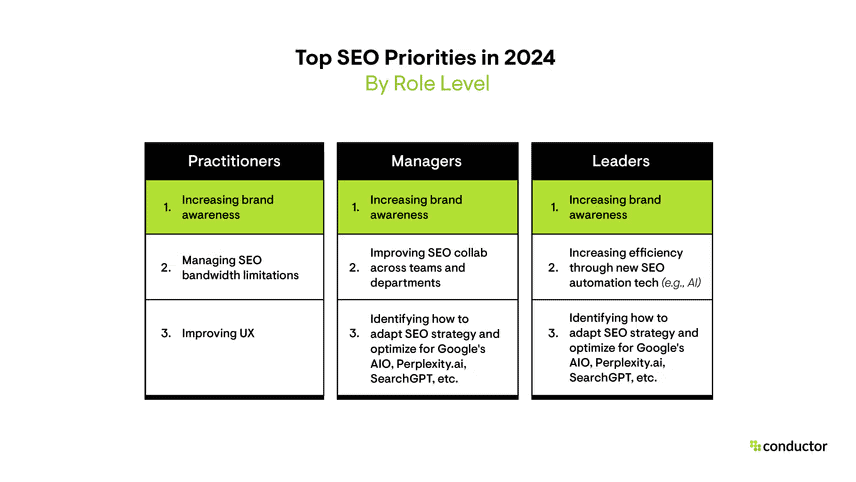
Dev teams usually have a lot on their plate, and they need to prioritize tasks and projects into sprints. Anything that isn’t prioritized doesn’t make it onto the calendar. To get these teams to help, you must show value. Managers often need to prove SEO ROI to secure more budget.
Large sites also need to manage multiple domains from one spot. They also need proper authentication and custom roles to keep things secure. This involves DevOps or IT security teams that manage permissions and authentication and work toward achieving certifications like SOC 2.
Huge sites also have messy architectures. You may need an enterprise SEO audit to identify deeper issues with your XML sitemaps.
Other capabilities include:
- Advanced reporting and analytics
- API access and integrations
- White-labeled options
- Dedicated support
- Automations
Which companies need enterprise SEO software?
Enterprise SEO software isn’t cheap, so you need to justify and offset the costs with ROI. You’ll likely need these tools if you have:
- Compliance requirements with international laws
- ROI tracking and executive reporting needs
- Integration with existing martech stack
- Multi-language SEO needs
- Complex site architecture
- Multiple stakeholders
- Security at scale
Pricing for these tools usually ranges from $30,000 to $150,000 per year. For a Fortune 1000 company, the conversions from higher rankings typically cover these costs.
Essential features of enterprise SEO software
A good platform acts like an extra team member. It handles the data so you can focus on your content marketing strategy.
Technical SEO capabilities
A site with millions of pages needs more than just a surface-level scan. You need tools that dig deep into the code and the server to ensure everything is running perfectly.
- JavaScript rendering to see what search engines actually index.
- Core Web Vitals monitoring to keep the User Experience fast.
- Log file analysis to track how bots use your crawl budget.
- Site crawling and auditing at a massive scale.
Proper monitoring is critical, especially during a website redesign SEO project, to prevent traffic loss.
Keyword research & tracking
Managing keywords for an enterprise isn’t about finding ten good phrases. It is about understanding thousands of terms across different regions and languages.
- Search intent analysis to match content with what users actually want.
- Access to a large-scale keyword database with billions of data points.
- Deep competitor analysis to find where rivals are winning traffic.
- Rank tracking across different devices and specific cities.
Modern tools also track SERP features like AI Overviews to show how users actually see your brand. This helps you monitor your share of voice across the industry and stay ahead of your rivals.
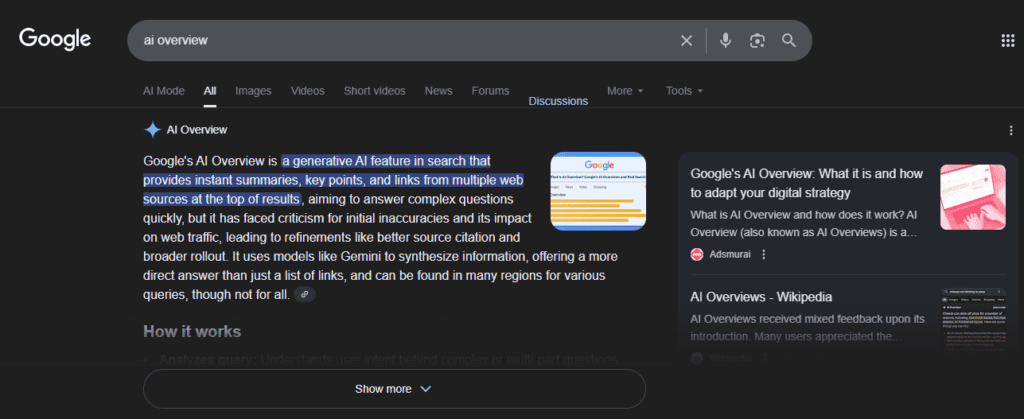
Screenshot taken by the author
Content optimization
Creating high-quality content at scale requires a repeatable process that removes the guesswork from your editorial calendar.
- Content performance tracking to see what actually drives conversions.
- Content gap analysis to find topics your rivals cover that you miss.
- On-page SEO recommendations to perfect every new page.
- AI-powered content insights to speed up the drafting phase.
Using an SEO content editor ensures your team stays up to date with the latest Google Search Console standards without slowing down. This helps your SEO stay consistent as you scale.
Link management
Backlinks are still the backbone of search engine rankings, but at an enterprise level, you need to manage them with precision and automation.
- Link opportunity identification to find high-value sites for mentions.
- Disavow file management to protect your site from spam attacks.
- Backlink analysis and monitoring to track your domain authority.
Enterprise teams often use techniques like digital PR link building to scale their authority-building efforts as part of their link building strategies. This builds brand awareness better than old-school tricks and keeps your backlink profiling clean.
Reporting & analytics
Executive teams don’t want to see a wall of numbers. They want to see how SEO impacts revenue and organic growth.
- Data visualization that makes complex trends easy to understand.
- Automated reporting to save your team hours every month.
- Integrations with Google Analytics and Search Console.
- Custom dashboards tailored to different stakeholders.
Cloud-based deployment and reporting help cross-functional teams align and stay aware so they can act when rankings change.
Collaboration & workflow
SEO is a team sport that involves writers, developers, and product managers all moving in the same direction.
- Team communication tools to reduce silos between departments.
- Task management to assign and track SEO tasks efficiently.
- Approval workflows to maintain quality across every page.
- User permissions and roles to keep your data secure.
Using a built-in task tracker ensures that important site audit fixes never fall through the cracks. This lowers risk management issues for your digital ecosystems.
Integration capabilities
Your SEO software should work with your existing tools. It shouldn’t be another silo in your digital marketing stack.
- Marketing automation platforms to connect search with email or lead gen.
- CMS integrations for platforms like WordPress or custom builds.
- Custom API access for your own proprietary dashboards.
- Data warehouses to store your long-term search metrics.
Plus, easy integrations with Adobe or other major suites let you combine search data with different channels to see the whole user journey. A secure connection and proper authentication are always required for these big moves.
Top enterprise SEO software platforms compared
Choosing a partner depends on your team’s needs. Some tools focus on technical SEO, while others prioritize content.
| Platform | Best For | Key Strength |
| Conductor | Content strategy | AEO |
| BrightEdge | Large global brands | Data Cube and ROI forecasting |
| seoClarity | Unlimited data access | Transparent pricing and no limits |
| Lumar | Technical site health | Fastest crawler and CI/CD QA |
| Botify | Huge e-commerce sites | Fast crawl speeds and bot logs |
Platform 1: Conductor
Conductor is a top choice for teams focused on content optimization. It is a complete platform that combines visibility tracking with content creation.
They focus heavily on AEO to help brands show up in AI-powered answer engines.
Best for: Content-heavy brands that need to track visibility in both Google and AI Overviews.
Key strengths:
- Recognized as a Forrester Wave Leader for its AI-powered tools.
- Includes an AI Writer to help with content marketing.
- Holds SOC 2 and ISO 27001 security certifications.
- Tracks brand mentions in Perplexity and ChatGPT.
Considerations:
- Best for teams that prioritize content over deep technical code fixes.
- Pricing is custom, usually $30k to $50k+ a year.
- Offers a three-week trial for their Site Explorer.
Platform 2: BrightEdge
BrightEdge has led the SEO software market for 18 years. They serve most of the Fortune 100.
Their DataMind engine uses machine learning to identify market trends in real time.
Best for: Large firms that want a mature tool with heavy automation and ROI forecasting.
Key strengths:
- The Data Cube is a massive collection of search data.
- Provides daily rankings updates for top keywords.
- Autopilot features automate many SEO tasks.
- Integrates with Adobe and Google Analytics.
Considerations:
- The tool is complex and needs training time.
- Pricing starts around $40k and requires a sales call.
- Not for teams with a small SEO budget.
Platform 3: seoClarity
seoClarity is unique because it has no usage limits. You can run as many site audits as you want without extra fees. This is perfect for brands with many sites that grow fast.
Best for: Multi-site brands that want transparent pricing and unlimited keyword research.
Key strengths:
- Pricing starts at $3,000 a month with no hidden fees.
- They build new features based on client feedback.
- Clarity ArcAI tracks your brand in AI Overviews.
- Boasts a keyword database of 30 billion terms.
Considerations:
- The interface can be hard to learn at first.
- You still need a high budget for the full Searchmetrics Suite of tools.
- 60% of their users switched from another platform.
Platform 4: Lumar
Lumar (formerly DeepCrawl) is a “website intelligence” platform built for speed and technical precision. It uses an ultra-fast cloud-based crawler to monitor site health across massive domains.
Lumar goes beyond standard SEO by auditing site speed and compliance with the Web Content Accessibility Guidelines (WCAG).
Best for: Brands managing complex site migrations or teams that need constant technical monitoring across hundreds of sites.
Key strengths:
- Protect feature for QA testing in the CI/CD pipeline to catch errors early.
- Market-leading crawler speed built on flexible cloud infrastructure.
- Monitor Hub for unified trend tracking across multiple domains.
- Deep focus on accessibility and technical site health.
Considerations:
- Very developer-centric, which might be a hurdle for pure content marketers.
- Pricing is custom, with enterprise tiers estimated between $30k and $70k per year.
- Lighter on content intelligence features compared to Conductor.
Platform 5: Bozify
Botify is excellent for giant e-commerce sites. It has the fastest crawl speeds, hitting 250 URLs per second. This is ideal for managing your crawl budget on sites with millions of products.
Best for: E-commerce sites that need deep technical SEO and bot data.
Key strengths:
- Tracks everything from the bot crawl to the final conversions.
- PageWorkers lets you fix SEO issues without a developer.
- Log Analyzer scans millions of bot requests a day.
- Botify Assist uses AI to turn data into action.
Considerations:
- You need a technical background to use it well.
- Prices can go over $60k per year.
- Not as strong for content marketing strategy as some rivals.
How to choose the right enterprise SEO software
Whether you’re searching for best map plugin for WordPress or you need to pick a tool for other needs, it’s a big step requiring a clear plan. Use these steps to ensure you don’t waste your budget on a tool that doesn’t fit.
Step 1: Assess your needs
- Identify your primary search challenges, from local SEO to global reach.
- Consider your company size and the scale of your enterprise website.
- Set a realistic budget range before interviewing SEO vendors.
- Evaluate your SEO team size and existing structure.
Step 2: Define must-have features
- Map out what has to plug into what: Adobe, Google Ads, your CMS, or anything else in your stack.
- Note your non-negotiable tech needs, like JavaScript rendering and structured data support.
- Pick collaboration features that fit how your team already works, not the other way around.
- Get clear on the reporting and deeper analytics your leaders expect to see.
Step 3: Evaluate options
- Read customer reviews and dig into case studies on sites like Gartner.com before you sign anything.
- Book live demos with 3–5 vendors and have them walk through your actual site and data.
- Use free trials to stress-test automation and see how accurate the rank tracking really is.
- Bring in dev, content, and digital marketing early so you’re not choosing in a vacuum.
Step 4: Consider the total cost of ownership
- Confirm whether your package includes ongoing support and a dedicated account manager.
- Plan for setup time and training, especially for deeper features like Rank Tracker.
- Account for the staff time required to manage manual SEO tasks.
- Look beyond licensing costs to find hidden fees for crawl limits.
Step 5: Plan for implementation
- Manage the change as your team moves from basic tools like Screaming Frog or Sitebulb.
- Create a clear onboarding timeline to ensure a smooth connection to your data.
- Pick success metrics like improved Share of Voice or higher website traffic.
- Set training requirements for tools like Site Explorer or Siteliner.
Conclusion
Choosing the right enterprise SEO software is a major decision. The right tool acts as a force multiplier for your team. It lets a few people manage a huge enterprise website with ease.
Whether you need the power of Botify or the content help of Conductor, there is a tool for your SEO strategy. Make sure it works with any specialized platforms that you need, such as local SEO tools if you have a local physical business.
The goal is to drive conversions and stay visible as search changes. With AI Overviews and Perplexity on the rise, you need a partner that keeps you ahead.
So, take the time to run trials and involve your team. Ask them to test it for their use cases and consider their feedback before committing. After all, you’re investing part of your budget for a higher ROI and better efficiency.
Want to stay up-to-date with SEO changes? Subscribe to the SEO Power Plays newsletter for the latest updates.