I’ve spent the past decade building SEO for 525+ brands. That means I’ve also seen just about every way agencies fail their clients.
Wondering how to hire an SEO agency without regret? Use this playbook to vet your options. Below, I’ll show you what separates real agencies from the noise. You’ll learn how to decode proposals, spot contract red flags, and test claimed results before you commit your budget. 👇
Highlights
- Hiring an SEO agency means you’re trusting a team to make strategic decisions with your marketing budget. Before signing, verify three things: they can diagnose the right problems, execute consistently, and prove they create business results, not just rankings or traffic.
- The biggest hiring mistakes happen when businesses compare price, deliverables, and promised timelines. They should be judging strategy instead. A reliable SEO proposal explains why specific recommendations are being made. Weak proposals rely on generic packages and sales language.
- The fastest way to separate legitimate SEO agencies from weak ones is to ask difficult questions. Ask how they measure success, who manages your account, how they build links, how they verify results, and what happens when performance stalls. Strong agencies answer questions with specifics, not reassurances.
- A trustworthy SEO proposal should include prioritized recommendations, realistic milestones, business-focused KPIs, transparent pricing, reporting expectations, and clearly defined responsibilities. Be cautious with proposals that guarantee rankings, rely on templates, or focus on deliverable counts instead of outcomes.
- Always verify an agency’s claimed results before signing. Check case studies with independent SEO tools. Ask for Google Search Console proof when you can. Ask references about real business outcomes. Then compare every agency with the same discovery-call checklist.
How to hire an SEO agency: What it really means
Hiring an SEO agency means trusting someone to make strategic decisions with your marketing budget.
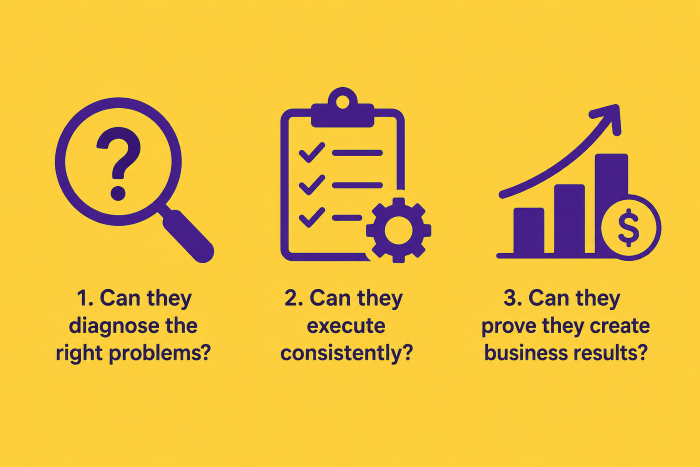
The 3 core things to verify before signing with an SEO agency
(Image by Ioana)
Before signing a contract with an SEO agency, you need to know:
- Can they diagnose the right problems?
- Can they execute consistently?
- Can they prove they create business results?
A reputable SEO team should be able to explain their thinking, demonstrate a repeatable process, and back up their claims with verifiable results.
If they can’t, keep looking.
Why most SEO agency searches go wrong
SEO agency searches go wrong when teams compare surface details. Think pricing, deliverables, and how fast an agency says it can get results.
I see this showing up in two main ways:
1. The proposal problem
Proposals are designed to win your business, so they’re easy to misread.
Their job is literally to emphasize benefits and overcome buyer hesitations. My roots are in copywriting. I know a sales document when I see one.
A reliable team will spell out WHY they recommend their approach in their proposal. They won’t rely on sales psychology terms and deliverable promises to try to woo you.
If they’re focusing on blog volume and price, you’re just evaluating outputs.
For example, my team doesn’t send a proposal until we’ve identified the biggest opportunities on the website and prioritized them. Every recommendation has to earn its place.
2. The timeline expectation gap
Some agencies promise fast results. Others hide behind “SEO takes time” claims to avoid taking accountability for shitty strategies.
Reputable agencies set realistic expectations.
They walk you through what can happen in the short and long term. They also explain how they measure progress at each stage. For example, we tell our clients what success looks like after 30, 60, and 90 days, then map out how results should build over the next six to 12 months.
The questions SEO agencies hope you never ask (steal this checklist)
The best way to evaluate an SEO agency is to ask questions that reveal how their team thinks and responds when things don’t go to plan.
A Reddit user recently said:
“I would prefer to partner with an SEO company that is upfront about its challenges than to align myself with an organization that boasts grandiose claims about success.”
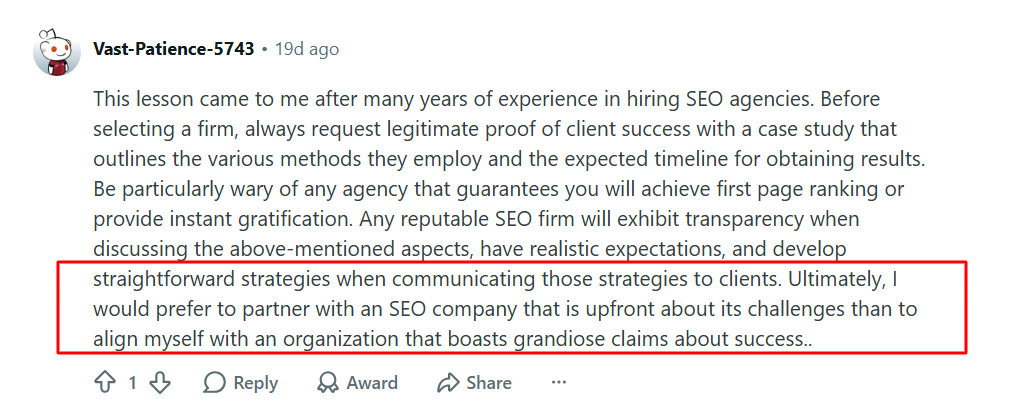
Couldn’t have said it better myself.
That was after another Redditor recently asked:
“What do I need to avoid when hiring an SEO firm? What are some red flags? And questions I need to be asking prior to signing a contract?”
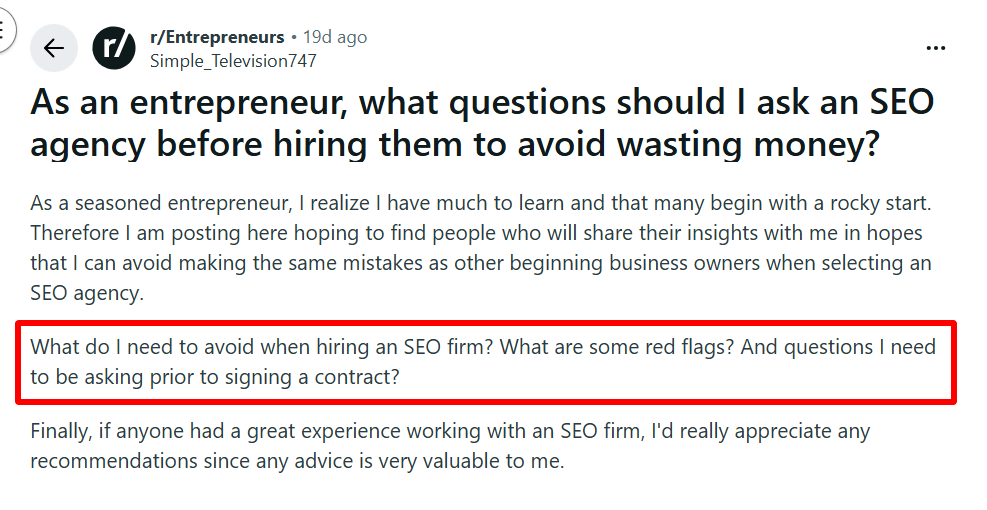
Any agency can promise rankings all they want.
The agencies that are worth hiring should be comfortable answering the questions below with specific examples and supporting evidence. 👇
- How do you define and measure success? They should measure success by business outcomes like MRR and number of new SQLs, not rankings alone. At my agency, we track rankings and traffic, but we judge success by the business impact those metrics create. They only matter if they translate into leads, pipeline, and revenue.
- Who works on my account day to day? You should know exactly who’s managing your account and how to reach them.
- What does your link building process look like? A legitimate agency should be transparent about its link building process. (Do they earn editorial placements? Conduct outreach? Guest post? Have relationships with reputable publishers?)
- Can you verify the results you’re claiming? You should be able to validate their performance claims with real, verifiable data. Ask for Google Search Console, GA4, or Ahrefs screenshots that match the timeframe they’re claiming. For leads, pipeline, or revenue, ask how the results were measured. Then ask if the agency can share CRM or attribution reports to back up the claims.
- What happens when things aren’t working? Smart teams have a backup plan when results stall. (For example, reclaiming lost backlinks, addressing technical issues, updating content, or shifting priorities based on performance.)
How to decode an SEO proposal
| Green flags | Red flags |
| References your website specifically | Shows you a generic template or mockup example |
| Explains strategic priorities | Lists services |
| Includes milestone goals | Only references monthly deliverables |
| Defines KPIs that matter to your business | Mentions rankings only |
| Supports its claims with case studies and data | Guarantees outcomes they can’t control |
| Shows reporting cadence | No communication plan |
What a strong proposal includes
A strong proposal explains (and proves) exactly what you’ll get and how the engagement will work.
It lays out:
- A clear scope of work.
- Prioritized recommendations based on your website, competitors, and business goals.
- Realistic timelines and milestones.
- Roles and responsibilities.
- Defined KPIs and reporting cadence.
- Transparent pricing with no hidden fees.
- Clear next steps.
Red flags hiding in plain sight
Some of the biggest warning signs I see in proposals are easy to miss. Consider them the SEO equivalent of dating red flags. Don’t assume they’ll improve once the contract is signed. 🤦🏻♂️
Watch out for proposals that:
- Promise guaranteed rankings or traffic
- Use generic, copy-and-paste templates or mockups
- Hide pricing or scope behind broad terms
- Focus heavily on deliverable counts
- Have no reporting expectations
- Avoid defining success
- Leave timelines vague
Contract terms that should give you pause
This should go without saying, but ALWAYS read the fine print in the contract before signing.
I recommend holding onto it for a few days. Make ’em sweat a bit.
Watch out for:
Lock-in clauses and exit penalties
Be wary if an agency asks for half a year’s notice before you can leave. The same goes for a penalty to exit the contract.
SEO isn’t a one-month project. Six- and 12-month agreements are standard practice. But if an agency is confident in its work, it shouldn’t need six months’ notice or hefty exit fees to keep you around.
“Proprietary” systems and vague deliverables
I’ve seen agencies use “proprietary” to describe everything from reporting dashboards to basic SEO processes.
That’s fine if they’re protecting a genuine competitive advantage. (Hell, my agency has them.)
But it’s a problem if “proprietary” becomes an excuse to avoid explaining what they’re doing.
While you’re reading the contract, confirm who owns the work being created. That includes content, reports, dashboards, analytics accounts, and any other assets produced during the engagement. You shouldn’t have to fight for access to your own marketing data if you decide to move on.
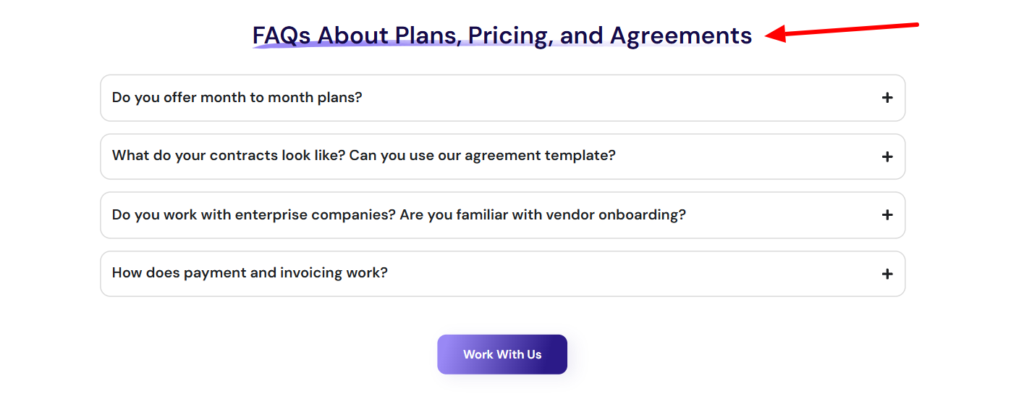
If you don’t have a contract in front of you yet, see if they have an FAQ section on their website about contracts in the meantime.
How to pressure-test claimed results before you sign
Make sure to pressure-test claims before signing an SEO partnership agreement.
You need to:
Verify each case study independently
Don’t believe every customer story you read.
The only way to know if a case study is legit is to validate it yourself.
I recommend:
- Checking whether rankings, traffic, or backlinks moved during the timeframe the agency claims.
- Looking up the client’s organic visibility using tools like Ahrefs or Semrush.
- Asking for Google Search Console screenshots.
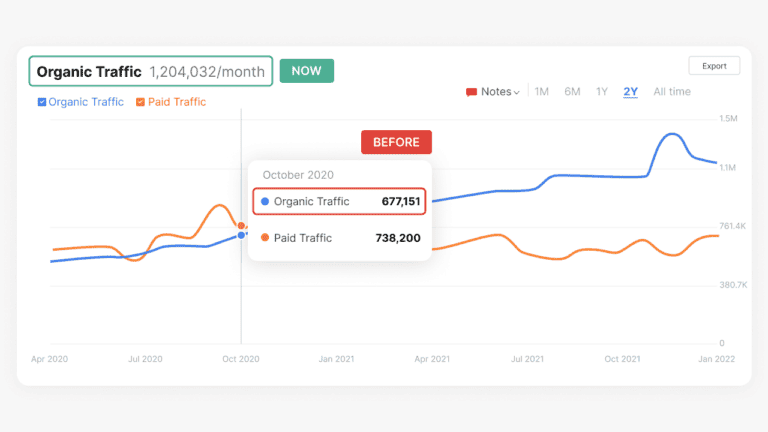
If an agency claims it helped a client grow MRR or generate more leads, ask how those results were measured. (They might not be able to share confidential analytics. But they should be able to explain the attribution, timeframe, and methodology behind the numbers.)
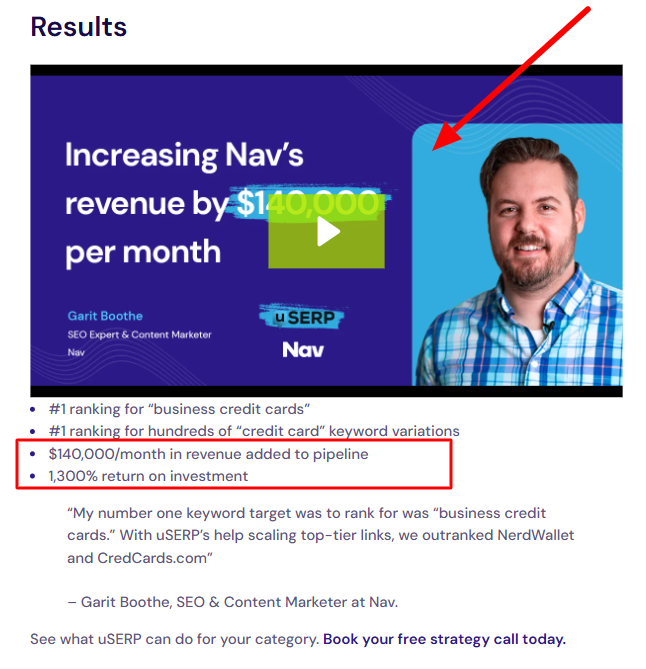
Better yet, ask for customer testimonial videos so you can hear it from the horse’s mouth:
Get the most from reference calls
Reference calls are your chance to ask questions agencies won’t answer for themselves.
But for the love of Google, don’t ask references if they were “happy” with an agency. That tells you nothing.
Ask what surprised them and what didn’t go as planned. Ask how the agency handled setbacks. Then ask if they’d hire the agency again, knowing what they know now.
THEN ask for their results.
What were their goals before hiring the agency? Did the agency meet or exceed those goals? What did the agency do to meet (or try to meet) those goals?
Also ask how responsive the agency was and how often the strategy changed based on results. Did communication match what was promised during the sales pitch? Those answers tell you more about the working relationship than a case study could.
Use my question checklist during discovery calls
Make sure to have my question checklist in front of you during every discovery call. (Scroll back up to the top of this guide, copy it, and paste it inside a Google Doc so you can reference it on calls.)
Ask every agency the same questions so you can compare answers objectively.
Conclusion: How to hire an SEO agency that earns its retainer
If you take one thing away from this guide, let it be this. 👇
The right agency for your business won’t expect you to take its word for anything. It’ll explain its strategy, show its work, answer difficult questions, and welcome healthy skepticism.
That’s the standard I’d hold any agency to, including my own. At my agency, we show clients exactly what our work is doing every month. We’ve helped companies reach their first six-figure year, scale to $24M ARR, and increase organic traffic by 78%.
If an agency can’t clear that bar before you’ve signed the contract, don’t expect things to improve afterward.
If you’re looking for a strategic partner that gives a fu** about your goals, let’s chat!
FAQs
Is it worth hiring an SEO agency?
Yes, if you’re hiring a team that thinks strategically, communicates clearly, and can prove its results. Otherwise, you’re paying for activity instead of outcomes.
How do I know if an SEO agency is legitimate?
Legitimate agencies welcome tough questions. They explain their process, share real examples, and back up claims with evidence instead of guarantees.
What services should an SEO agency provide?
That depends on your goals. Most engagements include technical SEO, content strategy, on-page optimization, reporting, and link acquisition.
That said, if every client gets the exact same package, I’d ask why. Packages should be tailored to your specific needs.
Should I hire an SEO agency or an in-house SEO team?
That depends on your budget and growth stage. Agencies give you access to multiple specialists at a lower investment.
An in-house SEO team offers deeper integration within your business, but get ready to pay for that. (You’ll be footing the bill for full-time salaries, benefits, and overhead.)
You also need to think about link building expertise. The biggest SEO gap we see in established B2B and SaaS companies is a weak backlink profile. Hiring someone to build premium links in-house isn’t cheap.
How do SEO agencies charge for their services?
Most SEO agencies charge a monthly retainer, but some offer project-based or hourly pricing.
I recommend focusing less on the pricing model and more on whether the scope of work justifies the investment.