
Publishing content that no one finds is one of the most common (and expensive) mistakes in digital marketing. The gap between “content” and “SEO content” is wider than most people realize.
Here’s the truth …
Generic content agencies produce well-written pieces that don’t rank. SEO agencies drive traffic but sometimes sacrifice readability and depth. SEO content services aim to close this gap. You get quality pieces that also rank.
Let’s take a look at what SEO content services include, what separates strong providers from weak ones, and how to choose the right fit for your goals.
Highlights
- SEO content services help you create content that both ranks in search and attracts the right audience.
- They combine keyword research, search intent, structured briefs, strong writing, and on-page optimization.
- Good providers focus on strategy and quality, not just producing a high volume of content.
- They also track performance and update content to keep it competitive over time.
- Choosing the right provider comes down to their process, samples, and how well they align content with your business goals.
What are SEO content services
With endless grifters on LinkedIn, I want to clear the air on what quality SEO content services actually means. Here’s a specific definition, plus what it includes, how it compares to regular content writing, and who uses SEO content services. 👇
(Image by Ioana)
A working definition
SEO content services are managed offerings where a provider handles some (or all) of the workflow involved in creating content that’s designed to rank in search engines and serve a specific audience.
This typically includes:
- On-page SEO optimization (optimizing meta titles, descriptions, heading structure, and internal links)
- Keyword research and topic selection
- Content briefs or outlines
- Publishing (sometimes)
- Writing and editing
Effective SEO content agencies will tailor your entire SEO strategy according to your unique business goals. (More on what good SEO content services include in a bit!)
SEO content vs. regular content writing
Regular content writing produces well-crafted copy. It sounds great, but without an SEO strategy, it’s just pretty prose on a page.
SEO content starts with a keyword target, maps to search intent, structures content around what ranks, and optimizes every on-page element. SEO content writing also produces high-quality content grounded in subject-matter expertise.
The difference shows up in the results …
Regular content can educate your existing audience. SEO content attracts new readers who didn’t even know you existed.
Who uses SEO content services?
Teams that use SEO content services include:
- Marketing teams that have a content strategy but lack the bandwidth or specialist skills to execute it consistently.
- Businesses entering a new niche or market who need to build topical authority from scratch.
- Agencies that want to white-label or scale content production without hiring in-house.
- Businesses looking to scale what’s already working without hiring in-house.
What good SEO content services include
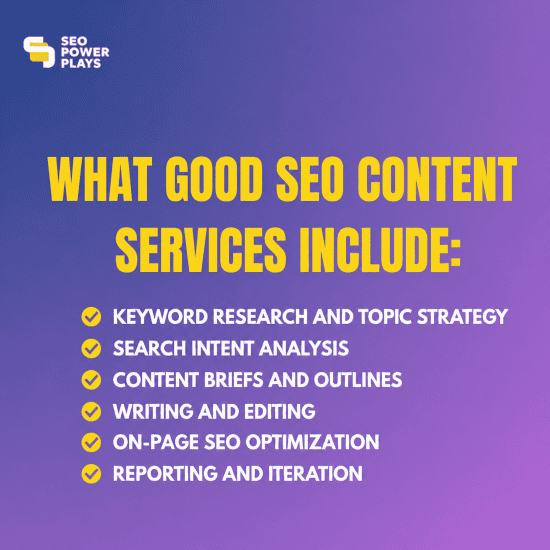
Here’s what a solid SEO content agency will include in their services:
(Image by Ioana)
Keyword research and topic strategy
A strong provider will pressure-test every keyword before it ever becomes a piece of content.
(This isn’t pulling a list from Ahrefs and calling it a day, btw.)
It’s asking: Does this align with your product? Can you realistically rank? And does it bring in the right kind of traffic?
You don’t want empty traffic. You want visitors who are moving toward a decision.
Good providers also think in systems, not one-offs. Instead of assigning random keywords to random blog posts, they build content clusters. One core topic gets supported by multiple related pieces. Over time, this creates a topical content network that reinforces itself.
This is how you move from “we rank for a few keywords” to “we own this topic.”
If there’s no clear roadmap behind what’s being published, you’re not building authority or dominating SERPs. You’re just adding pages.
In fact, research by the Content Marketing Institute reveals that strategy refinement is the top focus for most enterprise marketers (73%) because it works!
Search intent analysis
This is one of the most overlooked pillars in SEO content strategy. And it’s usually the reason content underperforms.
Every keyword reflects an intent: informational, navigational, commercial, or transactional. The content format has to match that.
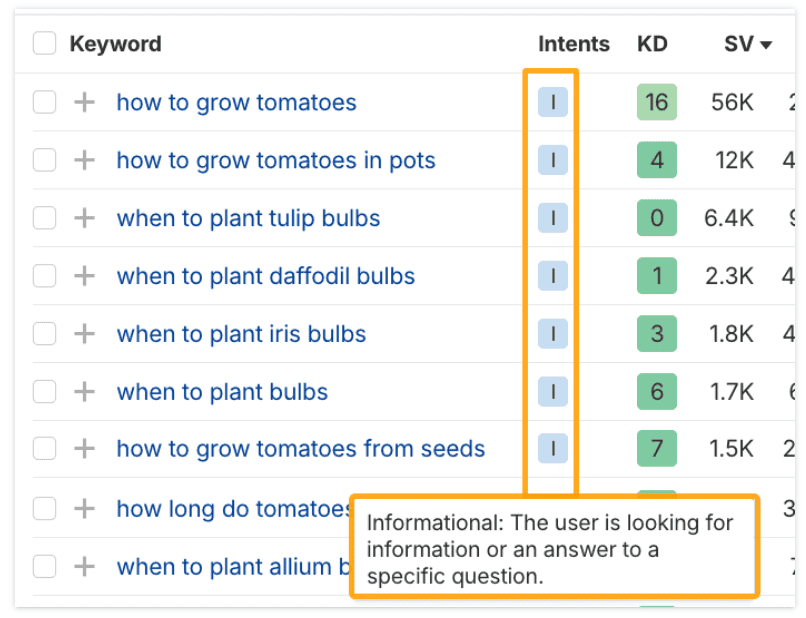
So a keyword like “what is content strategy” calls for an educational guide. And a term like “SEO content services” calls for a comparison blog post or a product page. If your content doesn’t align with that iintent, it won’t rank. (You’ll have well-written content that doesn’t perform because it’s in the wrong format for the query.)
Strong providers don’t guess here.
They look at the SERP and reverse-engineer what Google is rewarding. Are the top results guides? Listicles? Landing pages? Are they surface-level or deep? Are they written for beginners or experienced buyers?
Then they match that format. But they also improve it with a better structure, clearer explanations, and stronger examples.
Remember, you’re meeting a user at a specific stage in their journey. Your content needs to reflect that.
Content briefs and outlines
This is where the SEO content writing process starts.
Providers create strong content briefs that lay everything out upfront. This includes the target keyword, supporting keywords, search intent, suggested structure, key points to cover, and competitor content worth analyzing. (The writer shouldn’t have to guess what to include or how deep to go. They should be working from a clear plan.)
This is also what separates strategic SEO content from standard content writing.
Without a detailed brief, you tend to get surface-level articles that blend in with everything else on the SERP. With one, you get content that’s intentional, complete, and built to stand out.
Writing and editing
After briefing, SEO content service providers begin writing and editing. The final content should be accurate, easy to read, and genuinely useful, not stretched to hit a word count.
Strong providers focus on clarity, depth, and how well the piece helps the reader. They work with experienced writers and make sure content gets to the point without losing substance.
Editing is where quality gets locked in, so make sure to ask how their process works.
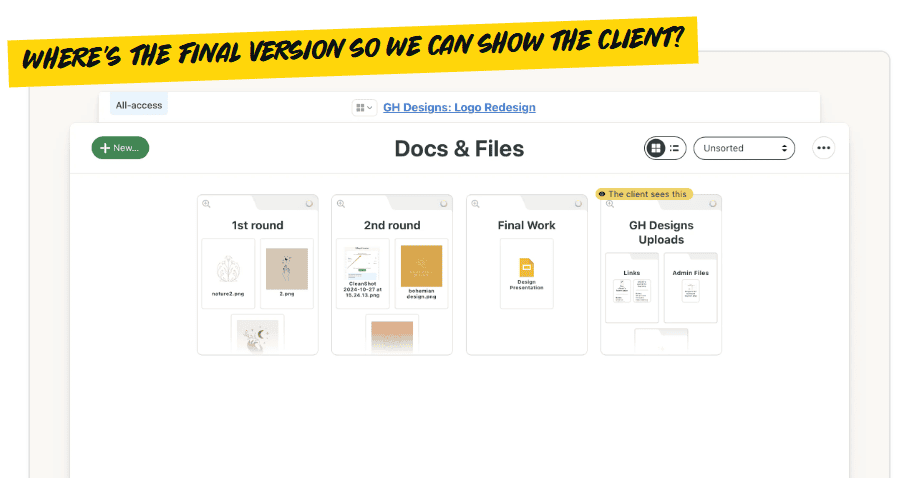
Does every piece go through a dedicated editor? Is someone reviewing for clarity, flow, and accuracy, not just grammar? For more technical topics, is there a subject-matter review?
If there’s no real editing layer, you’ll feel it in the final output.
More on what to ask SEO providers in a bit!
On-page SEO optimization
Once the content is written, it needs to be optimized to perform.
This starts with the fundamentals: Placing the primary keyword in the H1 and early in the content, writing a clear meta title and description, structuring headings properly, and adding internal links that connect to relevant pages. Image alt text should also be included where it makes sense.
Stronger providers treat this as part of the SEO content strategy. They make sure each element supports how the page shows up in search and how users move through your site.
Depending on the scope, some will also handle technical elements like schema markup and canonical tags.
Reporting and iteration
Once the content is live, strong providers track how each piece performs over time. This includes monitoring rankings, organic traffic, and how users engage with the page.
They also use that data to inform future content priorities and updates. If a page is ranking but not getting clicks, they revisit the title and meta description. If it’s getting traffic but not converting, they adjust the structure, messaging, or internal links. If it’s stuck on page two, they strengthen the content based on what’s already outranking it.
They also treat content as something that needs maintenance. Even strong-performing articles can lose ground if they’re left untouched. Good providers stay ahead of that. They refresh content, expand sections, and keep key pages competitive.
How to evaluate SEO content service providers
Now that we’re clear on what strong SEO content services include, let’s take a look at how to vet out an SEO content provider, including the exact questions to ask.
Check their own organic performance
An SEO content provider who can’t rank their own content may signal a credibility gap. Look at their blog. Do they rank for relevant terms? Do their articles show up in organic search? If they can’t rank their own content, they may struggle to rank yours.
(Also, just a fair note that some marketers are busy helping other clients rank. And that’s why their blog isn’t in tip-top shape. Still, it’s something to be aware of!)
Ask for process documentation
Strong providers can walk you through exactly how they go from keyword to published piece. If the answer is vague, their output will be inconsistent.
Ask specific questions to uncover their processes.
Here are some important ones to ask:
- What does your content production workflow look like?
- What does your editing workflow look like?
- Who handles keyword research?
- How do you build content briefs?
Review sample content critically
Take a close look at the provider’s writing samples to see if they align with your niche, target audience, and SEO best practices. And beware of any AI slop. 🤢 Not only does it sound generic, it’s also driving SEO costs up, not down.
Look for:
- A match between the content format and the likely search intent
- Specific, original insights (not generic advice)
- Natural keyword usage (not stuffed)
- A clear heading structure
Avoid providers whose samples read as interchangeable. (Where every article could be about any company in any niche.)
Understand their pricing model
Pricing shapes behavior, so it’s worth paying attention here.
Some SEO content service providers charge per-word, per-piece, or by retainer:
- Per-word pricing is usually budget-friendly, buy it may incentivize padding.
- Per-piece pricing can work if the scope is well-defined.
- Retainer pricing is most effective for sustained campaigns with a consistent publishing cadence.
Here’s a screenshot of uSERP’s SEO packages with transparent retainer pricing for high-growth brands. 👇
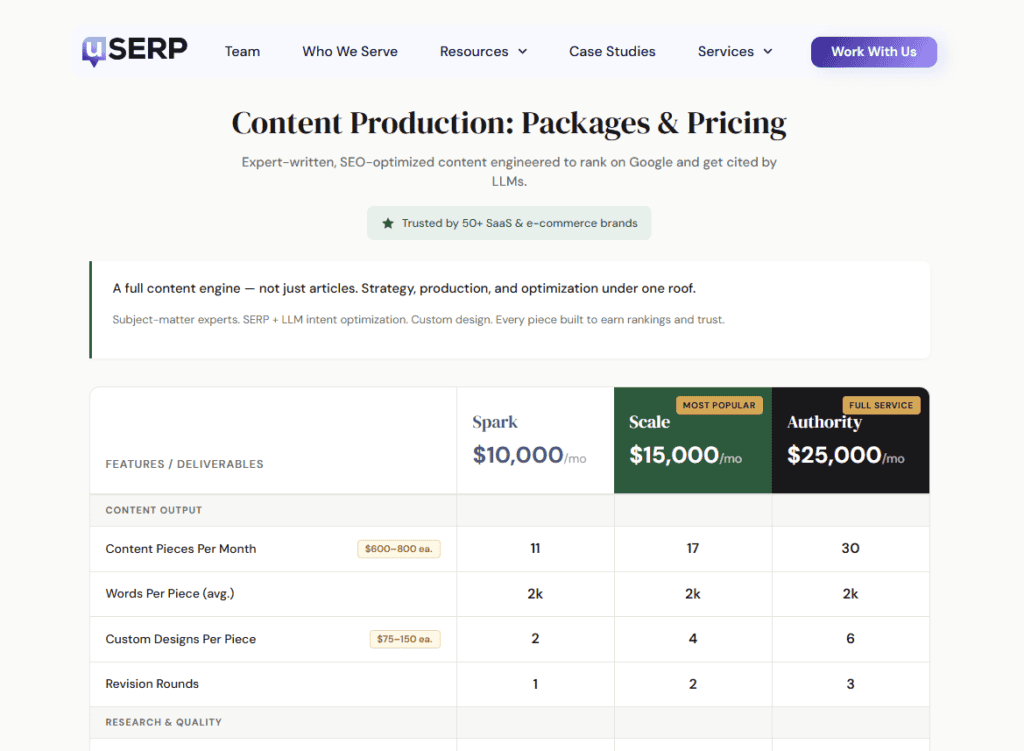
Whichever model you choose, make sure reporting is included, and not an add-on. (See below.)

Questions to ask before hiring
Before committing to a provider, ask the following questions to see how they think.
1. Start with how they approach keyword selection.
Ask: “How do you select keywords for a new client, and how do you prioritize which to target first?”
Do they prioritize based on business impact, ranking difficulty, and intent? Or are they just pulling lists from a tool? Their answer will tell you how strategic the engagement will be.
2. Get a clear view into how much direction their writers get.
Ask: “What does a content brief look like? Can I see a sample?”
This shows whether there’s a consistent structure behind their work.
3. You’ll also want to understand who’s creating the content. Is it handled by in-house writers, freelancers, or supported by AI? And what does the editing process look like?
Ask: “Who writes the content … in-house writers, vetted freelancers, or AI-assisted production? What’s the editing process like?”
If they have strong subject-matter expert writers and documented editing workflows, you’re in good hands.
Speaking of subject-matter experts …
4. For more technical topics, get clear on how they ensure accuracy. Do they involve subject-matter experts or rely solely on research?
Ask: “How do you handle topics that require subject-matter expertise or technical accuracy?”
This is especially important if you need content for a very technical audience, like developers.
5. Finally, clarify expectations.
Ask: “What does success look like at 90 days, six months, and 12 months? How do you report on content performance, and how often?”
If they can’t answer these clearly, results will likely feel unclear too.
*Pro-Tip: Feel free to screenshot the following graphic so you have these questions at your fingertips when you need them. 👇
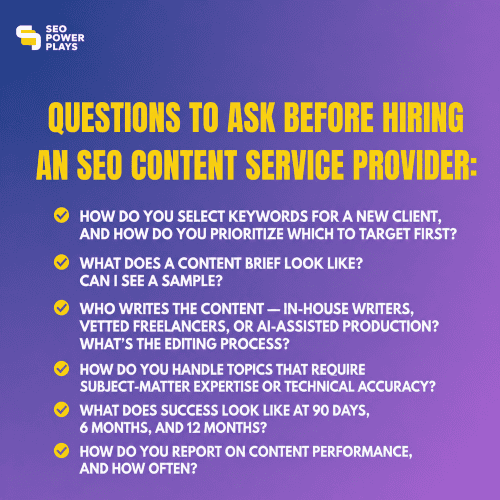
(Image by Ioana)
Get more from every piece of content you publish
SEO content services deliver the most value when they combine three things: strategic keyword planning, strong writing, and disciplined on-page optimization. If one of those is missing, performance will suffer.
If you’re evaluating a provider, you can always start with a small, three-month pilot engagement before committing to a long-term contract. This gives you a chance to see how they work, how they communicate, and how the content performs before scaling up.
The best providers are comfortable with this. They know their process works. And they’re willing to prove it.
P.S. Want to go deeper on SEO content strategy, tools, and best practices? Visit and subscribe to seopowerplays.com for deeper resources on SEO content strategy, tools, and best practices.